It's been a while. But in that a while, you could have amused yourselves with lots of media coverage on the alleged corruption in, again, Bulog.
Just one day before the first news broke up, one student came to me. She was furious at my liking the decision to import rice. But I made her convinced that while I'm all for rice market liberalization, I never like the idea of giving a monopoly to Bulog.
Dissolve Bulog.
Friday, March 30, 2007


Thursday, February 22, 2007
The Politics of Rice 25
The police seems to get it. But Kompas? Not really. A headline today reads, "The Police Caught Rice Speculators". That gives an impression that rice speculation is a crime (how about those guys speculation in the stock exchange, Sir?).
But if you read through, apparently the police's reason is different. What they are after is cheaters, not speculators. There are people who buy rice from Bulog at subsidized price and sell it to other with higher price (this is 'speculation', and I don't think is a crime) and replace the label as to hide that it is from Bulog (this is the cheating -- a crime).
Remember the fuel-kerosene cases? Yes, the story is similar. You should not punish me for buying subsidized Pertamina fuel, stocking up, and selling it at higher price. But when I mix it with kerosene and tell you that it is the same fuel you can buy at the gas station, I lie to you. I cheat. Punish me for that.
But if you read through, apparently the police's reason is different. What they are after is cheaters, not speculators. There are people who buy rice from Bulog at subsidized price and sell it to other with higher price (this is 'speculation', and I don't think is a crime) and replace the label as to hide that it is from Bulog (this is the cheating -- a crime).
Remember the fuel-kerosene cases? Yes, the story is similar. You should not punish me for buying subsidized Pertamina fuel, stocking up, and selling it at higher price. But when I mix it with kerosene and tell you that it is the same fuel you can buy at the gas station, I lie to you. I cheat. Punish me for that.
Wednesday, February 21, 2007
The Politics of Rice 24
According to Bustanul Arifin, if the Indonesian national socio-economic survey (the Susenas) is conducted and if the poor are sampled, most likely the poverty number will increase (supposedly due to the increase in rice price), a condition that worries the government.
I too believe that the absolute poverty is likely to increase -- the late harvest would not be able to compensate for the skyrocketing rice price.
But what strikes me is the fact that Bustanul implies that there is a possibility that the poor will not get sampled in the Susenas. That is ridiculous. Is he saying that you can actually exclude the poor from such survey?
I too believe that the absolute poverty is likely to increase -- the late harvest would not be able to compensate for the skyrocketing rice price.
But what strikes me is the fact that Bustanul implies that there is a possibility that the poor will not get sampled in the Susenas. That is ridiculous. Is he saying that you can actually exclude the poor from such survey?
Monday, February 19, 2007
The Politics of Rice 23
Aha, Kompas finally believes that the domestic rice supply is short. That's one step in the right direction.
I am not surprised that they are surprised.
I am not surprised that they are surprised.
Saturday, February 17, 2007
The Politics of Rice 22
So now they blame it on hoarders and speculators. Said newspapers, those who buy and stock up cheap rice for profit reason should be taken into jail.
I say bullsh*it.
Everybody should be free to buy anything he wants. Yes, you say the law prohibits stocking up of 'basic necessities'. Well, even that law is ridiculous.
Of course it seems unfair that in the midst of high demand, some people use the opportunity to make more profit. But, hey, that is the very nature of entrepreneurship. You give a bad name to 'speculation', but 'speculation' is what you do in business. Only good speculators ace in business.
Government, don't listen to those liars. If you want to discourage stocking up, create competition. Open up. Imported rice will do the job. Not prison bars.
I say bullsh*it.
Everybody should be free to buy anything he wants. Yes, you say the law prohibits stocking up of 'basic necessities'. Well, even that law is ridiculous.
Of course it seems unfair that in the midst of high demand, some people use the opportunity to make more profit. But, hey, that is the very nature of entrepreneurship. You give a bad name to 'speculation', but 'speculation' is what you do in business. Only good speculators ace in business.
Government, don't listen to those liars. If you want to discourage stocking up, create competition. Open up. Imported rice will do the job. Not prison bars.
Saturday, February 10, 2007
Joyful flood or bad journalism?
So people are mad at Minister Aburizal because of his remarks on the flood disaster. It was shown in a TV news, the minister was saying that all the bad news about flood in Jakarta within the last week was an exaggeration. The fact is, according to the minister, what we see on TV is happy flood victims who, while talking to the reporters, are smiling and laughing with joy.
I would have said the same thing. Aburizal was quite right. I mean, come on, turn on your TV now, pick any domestic channel and watch the news. Now, do you see that reporter swimming wet with a yellow rain coat struggling to keep his microphone dry? Yes. Wait until he gets to interview some random flood victim. There he is. He usually goes standard, ‘Pak, what do you think about the flood?’ And the interviewee goes ‘Well, my house is two meter sunk now (smiling). The government should help us (laughing)’. In the background, his fellow victims are waiving hands to the camera, and kids are free jumping to the brown water with joy.
So who says Minister Aburizal was wrong? I agree with him: people do look happy.
But I’m not Aburizal. The way I see this is beyond laughing. What I see is a terribly bad journalism. I don’t think the bad news about flood disaster is exaggerated. But I think those TV journalists fail to bring us the true picture of reality.
The thing is, they are lazy. Instead of documenting the very life of the victims: how they can’t sleep because of water and starving, how they cope with extremely poor sanitation, how they try to keep their babies alive, and so forth; they, the reporters, choose the easiest way: random interview with useless questions. (Well maybe not too lazy, because they seem pretty heroic: they jump into the water – but what is the point? Let’s see: Now that there is this new fatal disease, the evil amalgam of dirty flood water and mouse urine, are they still going to give life report swimming?).
I guess the journalists could use some economics principle: trust what one does, not what he says. Please, do not give us crappy interviews, because they are nothing but sweet talks. Show us the reality. Show us how the people live their life. More cameras and fewer microphones will do the message (and avoid Aburizal’s misunderstanding).
I would have said the same thing. Aburizal was quite right. I mean, come on, turn on your TV now, pick any domestic channel and watch the news. Now, do you see that reporter swimming wet with a yellow rain coat struggling to keep his microphone dry? Yes. Wait until he gets to interview some random flood victim. There he is. He usually goes standard, ‘Pak, what do you think about the flood?’ And the interviewee goes ‘Well, my house is two meter sunk now (smiling). The government should help us (laughing)’. In the background, his fellow victims are waiving hands to the camera, and kids are free jumping to the brown water with joy.
So who says Minister Aburizal was wrong? I agree with him: people do look happy.
But I’m not Aburizal. The way I see this is beyond laughing. What I see is a terribly bad journalism. I don’t think the bad news about flood disaster is exaggerated. But I think those TV journalists fail to bring us the true picture of reality.
The thing is, they are lazy. Instead of documenting the very life of the victims: how they can’t sleep because of water and starving, how they cope with extremely poor sanitation, how they try to keep their babies alive, and so forth; they, the reporters, choose the easiest way: random interview with useless questions. (Well maybe not too lazy, because they seem pretty heroic: they jump into the water – but what is the point? Let’s see: Now that there is this new fatal disease, the evil amalgam of dirty flood water and mouse urine, are they still going to give life report swimming?).
I guess the journalists could use some economics principle: trust what one does, not what he says. Please, do not give us crappy interviews, because they are nothing but sweet talks. Show us the reality. Show us how the people live their life. More cameras and fewer microphones will do the message (and avoid Aburizal’s misunderstanding).
Wednesday, January 03, 2007
Blaming competition
People are good in blaming game. But, not only that. Some go beyond blaming game to disguised protection seeking. And some think they have more authority than they actually do. At least there are three cases recently that are in point.
First, shopkeepers (small scale traders) vs minimarkets vs hypermarkets. As reported in The Jakarta Post, shopkeepers are angry at minimarkets. One of them complains, "I lost most of my customers when a minimarket opened up right in front...". And the government of Jakarta, not surprisingly, thinks they have to do something regarding the competition. Says one city official, "We are trying to temporarily stop issuing licenses for the establishment of minimarkets, because there are too many shops opening up... ". Of course the minimarket people are not happy. ... says, "...". What do we learn from this? A) The Jakarta government is lousy in doing its job managing city zoning. But rather than dealing with it, they blame business competition. This is rational though, since by doing that, the government can use populist sentiment to gain sympathy. B). The minimarket rep seems to be just playing with words. He argues as if he is concerned with consumers' welfare. But go ask these minimarket guys about their opinion toward hypermarkets like Carrefour. Now it is just like a role-playing game: suddenly minimarkets would want protection from hypermarkets, just like shopkeepers want protection from minimarkets; in all case, consumers are actually of no concern.
Second, IGOS vs Microsoft. As reported by Tempo magazine, there has been furor over the government fishy decision to buy Microsoft softwares instead of using the open source IGOS. The Monitoring Committee for Business Competition (KPPU) accuses the government of violating Presidential Regulation No. 8/2006 that requires open bid for such procurement. The case made by KPPU is well taken. It is quite obvious that had the government run a tender process, IGOS would have won, because it is an open source. Using IGOS would therefore save taxpayers' money. But, KPPU should not go too far in its argument. For example, it argues that one benefit that would be gained by using IGOS rather than Microsoft is employment creation. As true as it might be, employment is not KPPU's business.
Third, the Adam Air missing plane. As covered by media (e.g. this and this), a passenger plane owned by one of the Indonesian carriers, Adam Air is missing. Some people have started to blame the high competition in air plane business as the root cause of this and other accidents. According to them, the low cost carriers have been pushing their costs to the limit while risking the safety. So, the government should re-regulate the market. It is true that low air fare might come with low safety level. But that is not an issue of competition. Rather, it is an issue of imposing and enforcing safety standard. If the safety rules are enforced, some of those cheap planes would be out of the business; without having to deal with competition policy. This is also the case of cheap medicines, for example. Some of those label-less drugs are out without approval from Health Department. But, it is again an issue of the government failure to enforce its safety regulation. It is not for competition policy.
Update: Rasyad Parinduri has a rebuttal here. Ujang and Arya have made the discussion clear. Thanks, guys. Sorry if I was being obscure. What I was really trying to say was that many times, we are lousy in X, but we blame Y and do something on Y instead of X, just because the former is easier even though it would not solve the problem. I accept Arsyad's point that "lower air safety is the consequence of competition"; it is very rational for business to use anything possible to minimize cost including finding ways around safety standards, if any. If I know that the government is lousy in enforcing safety standards, than I would economize on that; I would be stupid not to use that opportunity. Who's to blame? Cheap tickets? As Ujang said, this is not an easy thing (as indicated by the fact that I failed to make my point clear, I suppose): people can easily confuse safety and competition. Yes, they are related, but the policy implication would be very different. Imagine this: if somehow the government can really enforce a good safety standard on airline business, I would expect that tickets would be more expensive relative to the current fares. Note, however, that the business response is due to the enforcement of safety regulation policy, not competition policy.
As a side note, let me say one more thing before people accuse me with 'so-now-you-want-the-government-to-do-something' or 'wtf-you-oppose-seatbelt-requirement-but-you-want- safety-standards-on-airlines'. This is an issue of information. Air passenger has the rights to know whether the carrier he is going to use is too old to fly, has a cripple pilot, and so forth. Then he would make his own decision: cheaper ticket slash old bird slash cripple pilot or more expensive ticket slash newer carrier slash qualified pilot. Where is the government here? Its role is to make sure that the information is carried through. How? Well, let them think. But here's an illustration: require every airlines to announce the age of the carrier and the qualification of the pilot in ticket boxes. (Note that this is different with seatbelt case. When you buy a car or take a cab, you can check first whether it has a seatbelt or not. Then you decide. Unfortunately, you can not do this to airplanes).
First, shopkeepers (small scale traders) vs minimarkets vs hypermarkets. As reported in The Jakarta Post, shopkeepers are angry at minimarkets. One of them complains, "I lost most of my customers when a minimarket opened up right in front...". And the government of Jakarta, not surprisingly, thinks they have to do something regarding the competition. Says one city official, "We are trying to temporarily stop issuing licenses for the establishment of minimarkets, because there are too many shops opening up... ". Of course the minimarket people are not happy. ... says, "...". What do we learn from this? A) The Jakarta government is lousy in doing its job managing city zoning. But rather than dealing with it, they blame business competition. This is rational though, since by doing that, the government can use populist sentiment to gain sympathy. B). The minimarket rep seems to be just playing with words. He argues as if he is concerned with consumers' welfare. But go ask these minimarket guys about their opinion toward hypermarkets like Carrefour. Now it is just like a role-playing game: suddenly minimarkets would want protection from hypermarkets, just like shopkeepers want protection from minimarkets; in all case, consumers are actually of no concern.
Second, IGOS vs Microsoft. As reported by Tempo magazine, there has been furor over the government fishy decision to buy Microsoft softwares instead of using the open source IGOS. The Monitoring Committee for Business Competition (KPPU) accuses the government of violating Presidential Regulation No. 8/2006 that requires open bid for such procurement. The case made by KPPU is well taken. It is quite obvious that had the government run a tender process, IGOS would have won, because it is an open source. Using IGOS would therefore save taxpayers' money. But, KPPU should not go too far in its argument. For example, it argues that one benefit that would be gained by using IGOS rather than Microsoft is employment creation. As true as it might be, employment is not KPPU's business.
Third, the Adam Air missing plane. As covered by media (e.g. this and this), a passenger plane owned by one of the Indonesian carriers, Adam Air is missing. Some people have started to blame the high competition in air plane business as the root cause of this and other accidents. According to them, the low cost carriers have been pushing their costs to the limit while risking the safety. So, the government should re-regulate the market. It is true that low air fare might come with low safety level. But that is not an issue of competition. Rather, it is an issue of imposing and enforcing safety standard. If the safety rules are enforced, some of those cheap planes would be out of the business; without having to deal with competition policy. This is also the case of cheap medicines, for example. Some of those label-less drugs are out without approval from Health Department. But, it is again an issue of the government failure to enforce its safety regulation. It is not for competition policy.
Update: Rasyad Parinduri has a rebuttal here. Ujang and Arya have made the discussion clear. Thanks, guys. Sorry if I was being obscure. What I was really trying to say was that many times, we are lousy in X, but we blame Y and do something on Y instead of X, just because the former is easier even though it would not solve the problem. I accept Arsyad's point that "lower air safety is the consequence of competition"; it is very rational for business to use anything possible to minimize cost including finding ways around safety standards, if any. If I know that the government is lousy in enforcing safety standards, than I would economize on that; I would be stupid not to use that opportunity. Who's to blame? Cheap tickets? As Ujang said, this is not an easy thing (as indicated by the fact that I failed to make my point clear, I suppose): people can easily confuse safety and competition. Yes, they are related, but the policy implication would be very different. Imagine this: if somehow the government can really enforce a good safety standard on airline business, I would expect that tickets would be more expensive relative to the current fares. Note, however, that the business response is due to the enforcement of safety regulation policy, not competition policy.
As a side note, let me say one more thing before people accuse me with 'so-now-you-want-the-government-to-do-something' or 'wtf-you-oppose-seatbelt-requirement-but-you-want- safety-standards-on-airlines'. This is an issue of information. Air passenger has the rights to know whether the carrier he is going to use is too old to fly, has a cripple pilot, and so forth. Then he would make his own decision: cheaper ticket slash old bird slash cripple pilot or more expensive ticket slash newer carrier slash qualified pilot. Where is the government here? Its role is to make sure that the information is carried through. How? Well, let them think. But here's an illustration: require every airlines to announce the age of the carrier and the qualification of the pilot in ticket boxes. (Note that this is different with seatbelt case. When you buy a car or take a cab, you can check first whether it has a seatbelt or not. Then you decide. Unfortunately, you can not do this to airplanes).
Tuesday, December 26, 2006
The Politics of Rice 21
Finally Kompas admits that rice import is necessary.
But, not surprisingly, Kompas goes on with its apologetic tone: "As long as it is supported by accurate data, importing rice is justified".
This argument has been used as well by economists who love export but hate import. Only if you notice, these are the people who always say that there is no reliable data on rice production. Yet, they argue using data from god knows where.
So, how can you justify a policy basing on data that are not reliable?
Paraphrasing their arguments, it goes like this:
My suggestion, if you don't trust data, trash them. If, as you say, production data are all lies, use price as indicator. What does high price tell you? Supply is short. What's so damn difficult?
But, not surprisingly, Kompas goes on with its apologetic tone: "As long as it is supported by accurate data, importing rice is justified".
This argument has been used as well by economists who love export but hate import. Only if you notice, these are the people who always say that there is no reliable data on rice production. Yet, they argue using data from god knows where.
So, how can you justify a policy basing on data that are not reliable?
Paraphrasing their arguments, it goes like this:
1. Import is OKWhat is it they are really trying to say?
2. As long as the domestic supply is really short, relative to the domestic demand
3. To be sure on # 2, look at the data on production
4. But be careful, because no data is to be trusted
5. So do not import
6. Or import...
7. As long as the production data is accurate
My suggestion, if you don't trust data, trash them. If, as you say, production data are all lies, use price as indicator. What does high price tell you? Supply is short. What's so damn difficult?
Friday, December 15, 2006
The Politics of Rice 20
So, now they panic with the very high price of rice. You've been warned, dear, you've been warned.
It's amazing that those who oppose rice market liberalization are still making empty rhetorics. You can say anything using fancy terms like 'agricultural revitalization' and all that. But as long as you distort the price, nothing will change.
Now I'm amused that people care about the skyrocketing rice price. I thought you want higher and higher price 'to help farmers'? Siswono, you happy now? Well, I guess you just don't care about Tarsemi, Darti and others.
By the way, I agree that the productivity issue should be addressed. Yes, but also, unleash the market. That way, you can see if you want to be productive or not. As I like to say, double productivity with double price means nothing.
And once again, I'm not a Bulog defender! No.
It's amazing that those who oppose rice market liberalization are still making empty rhetorics. You can say anything using fancy terms like 'agricultural revitalization' and all that. But as long as you distort the price, nothing will change.
Now I'm amused that people care about the skyrocketing rice price. I thought you want higher and higher price 'to help farmers'? Siswono, you happy now? Well, I guess you just don't care about Tarsemi, Darti and others.
By the way, I agree that the productivity issue should be addressed. Yes, but also, unleash the market. That way, you can see if you want to be productive or not. As I like to say, double productivity with double price means nothing.
And once again, I'm not a Bulog defender! No.
Sunday, November 26, 2006
New article on Indonesian economy
Now available online (subscription required)
M. Chatib Basri and Arianto A. Patunru, 2006. Survey of Recent Developments. Bulletin of Indonesian Economic Studies 42(3): 295-319I believe the print issue will be available next week.
Saturday, November 25, 2006
The Politics of Rice 19
"Importing rice is a very easy thing to do, but that is too simplistic, it can't attack the root of the problem of poverty in Indonesia".
That is the song the week.
Why is it if something is easy, we should go for the difficult ones? Welcome to the if-you-can-make-it-difficult-why-make-it-easy society.
That is the song the week.
Why is it if something is easy, we should go for the difficult ones? Welcome to the if-you-can-make-it-difficult-why-make-it-easy society.
Thursday, November 16, 2006
The Politics of Rice 18
As I said here, poverty increase in Indonesia has lots to do with the rice price. The World Bank report is in line with this claim, as reported in the media.
What is quite interesting is the tone-change of Kompas. Yesterday it ran this headline -- unusual for Kompas. Today, it changes tone back to its populist-leaning style. Yes, with the usual heroes quoted, of course.
Update: More from Kompas today. So, when an analysis is not like what you want, you can call it invalid. How cool.
What is quite interesting is the tone-change of Kompas. Yesterday it ran this headline -- unusual for Kompas. Today, it changes tone back to its populist-leaning style. Yes, with the usual heroes quoted, of course.
Update: More from Kompas today. So, when an analysis is not like what you want, you can call it invalid. How cool.
Tuesday, October 31, 2006
Forgiveness gone too far
Yes, I say this is an overforgiving (and others, too). What is the point of having a legal system when you keep reducing the sentence? Whatever happened to the "deterrent effect" you promised? Shame on you, Justice!
To all criminals and criminal-wanna-be's out there, you're in good hands. Take this opportunity. Go commit your favorite crimes. You got jailed, no problemo. Just act like a nice boy inside and they will cut your sentence every Eid Day and every Independence Day. If you are seen praying regularly, you might get even more. Even as many as 36 months! What a minute, that's 3 years, no? Good deal!
Oh, this is even better. If you're likely to get capital punishment, before the verdict, do demand for it. Yes, tell them, challenge them court people, that you want yourself killed. That capital punishment is what you want. Then, you'll still see the sun in the morning. And the next morning. And the morning.
Shame on you, Justice! Shame on you!
To all criminals and criminal-wanna-be's out there, you're in good hands. Take this opportunity. Go commit your favorite crimes. You got jailed, no problemo. Just act like a nice boy inside and they will cut your sentence every Eid Day and every Independence Day. If you are seen praying regularly, you might get even more. Even as many as 36 months! What a minute, that's 3 years, no? Good deal!
Oh, this is even better. If you're likely to get capital punishment, before the verdict, do demand for it. Yes, tell them, challenge them court people, that you want yourself killed. That capital punishment is what you want. Then, you'll still see the sun in the morning. And the next morning. And the morning.
Shame on you, Justice! Shame on you!
Friday, October 06, 2006
Incentivized journalist
I like that word, incentivized. And I can certainly understand Mankiw's frustration with bad journalists. That reminds me of a question from an audience in one conference last month. I was asked how the media played its role in Indonesian economic and political discourse. I said it sucks. My example was Kompas. If even the best media in Indonesia sucks, what do you expect?
Saturday, September 02, 2006
The Politics of Rice 17
So, the poverty rate has increased. Official statement from the Office of Statistics says, poverty line is very much affected by food prices. More specifically, the share of rice in households' expenditure is 35 percent. Not surprisingly, rice price increase contributes significantly to the increase in of poverty rate.
So, why not
... open up rice market?
Import now!
So, why not
... open up rice market?
Import now!
Wednesday, August 16, 2006
On country risk?
Who's afraid of country risk? Apparently, the newest UI econ Ph.D, Ferry Irawan is not one. I asked Irawan the following:
Capital flies to wherever it can get the highest returns. High interest rate is of course more attractive than the lower ones. Theoretically, dictated by the law of one price, interest rates between two countries equilibrate. But the prices should take into account all other differences between the two countries, most of which is attributed to "country risk premium". I don't have scholarly references right now, but it seems that some BI officials still assign a 600 bps (6 percent) rule. That means, all else constant, the Indonesian country risk is somewhere near 6 percent equivalent of interest rate.
But, as Irawan rightly responded, we should not be too religious on the so-called "600 bps"-rule of thumb. The "all other differences" is a dynamic concept. It can not be always 6 percent. Improvement in investment climate contributes to a reduction in the differential. Price stability is another factor, as pointed out in Irawan's dissertation.
As an afterthought, however, I would ask: why bother too much with all this "country risk"? After all, as finance people like to say, "the riskier the crispier". In fact, Cornell's Assaf Razin has shown that the share of FDI in total inflows is higher in riskier countries since "the micro-management superiority of FDI investors over their domestic counterparts is more pronounced when the corporate governance in the host country is weak and financial institutions are not well developed."
That is, riskier countries are sexier to exploit. You agree?
So Bank Indonesia has just [the exam was on Aug 11] lowered again its policy rate to 11.75 percent. Given the current Fed rate of 5.25 percent, there is a 650 basis points differential. If, the current "rule of thumb" holds, i.e. Bank Indonesia should maintain at least 600 bps above the Fed rate, then we still have a room of 50 bps. That means, we're fine if BI again cuts the rate to 11.25, provided that Mr. Bernanke keeps his words. Bank Indonesia officials yesterday have indicated their intention to make further cut, since the inflation rate is increasingly manageable. You agree?
Capital flies to wherever it can get the highest returns. High interest rate is of course more attractive than the lower ones. Theoretically, dictated by the law of one price, interest rates between two countries equilibrate. But the prices should take into account all other differences between the two countries, most of which is attributed to "country risk premium". I don't have scholarly references right now, but it seems that some BI officials still assign a 600 bps (6 percent) rule. That means, all else constant, the Indonesian country risk is somewhere near 6 percent equivalent of interest rate.
But, as Irawan rightly responded, we should not be too religious on the so-called "600 bps"-rule of thumb. The "all other differences" is a dynamic concept. It can not be always 6 percent. Improvement in investment climate contributes to a reduction in the differential. Price stability is another factor, as pointed out in Irawan's dissertation.
As an afterthought, however, I would ask: why bother too much with all this "country risk"? After all, as finance people like to say, "the riskier the crispier". In fact, Cornell's Assaf Razin has shown that the share of FDI in total inflows is higher in riskier countries since "the micro-management superiority of FDI investors over their domestic counterparts is more pronounced when the corporate governance in the host country is weak and financial institutions are not well developed."
That is, riskier countries are sexier to exploit. You agree?
Tuesday, August 15, 2006
Not good enough, Sir! It's still illogical
So, apparently the government listens. But the response is far from good. Again, we can't rely on The Jakarta Post web technology, so let me sum up:
Says The Jakarta Post:
Says The Jakarta Post:
The government is unlikely to press ahead with a proposal to force TV
stations with national coverage to merge as there are signs that some of them
are already on the verge of merging to boost efficiency.... [T]he government would not issue any directive requiring TV firms to merge in the foreseeable future
Right on. Even though, you don't even need the qualifier that some TV stations do want to merge. It's not your business. And what's with that "in the foreseeable future"? You still want to do it, don't you? My goodness.
And here goes the best part:
Because of the tight competition, [Minister Djalil] added, most of the stations were being forced to produce cheap, low-quality programs, such as soap operas, supernatural shows, gossip shows and crime programs... If there were fewer TV stations, each of them would be able to secure better advertising revenue. This would eventually enable them to improve their programs...
Alright now I'm confused. Crappy programs are reflection of lack of competition, Sir. You need to open up. Let Discovery Channel, National Geographic, Animal Planet and others reach the general public.1 Translate if you like. That, trust me, will make all those craps, including the stupid-but-addictive infotainments, on TV driven out. We don't even need a fatwa, yes?
And you say fewer TV stations would enable programs improvement? Oh, I wonder why can't we just go back to the monopoly, TVRI then? Or, why in the world in countries with good programs there are 50 channels, including education programs?
1 OK, some people start screaming at me. Am I saying we should let any station accessible by everybody -- kids? Well, let the family decide.
Monday, August 14, 2006
Dumping, anyone?
So, the United States Department of Commerce is going to impose a 118.63% antidumping duty to Indonesian's paper producer, PT Tjiwi Kimia, along with another 40.55% duty due to subsidy enjoyed by the company. Sounds typical.
If I were to draft a response letter, this is what I would send to DC:
Dumping is good. Antidumping policy is ridiculous. Subsidy is bad.
If I were to draft a response letter, this is what I would send to DC:
Dear Sir,
It is saddening to see how you sacrifice economic efficiency just to please some lousy producers in your country. Americans have been enjoying cheap papers from Indonesia. But because some American producers can not compete with us, you are going to make the paper price higher there. You are going to force your people to buy expensive paper from inefficient producers. How thoughtful. Let us tell you, Sir. You should thank us for dumping cheap papers to your country.
Of course you complain about subsidy we give to our paper producers. Yes, you are right on this one. Subsidy is evil. Just like your subsidy to your farmers. Let's stop all subsidy, would you?
Dumping is good. Antidumping policy is ridiculous. Subsidy is bad.
Monday, August 07, 2006
Biofuel, anyone?
I can understand SBY's interest in developing biofuel. In the time of rising oil price (which is natural by itself), it is not surprising that people turn to, or look for, substitutes. Biodiesel and ethanol are logical solutions to the increasingly thinly supplied fossil fuel.
But, let's not be too excited as to exploiting the resources in the wrong time. (By "wrong" I mean, the price hasn't told us yet that it is time to switch).
One thing that people tend to overlook when talking about biofuel is the production costs of it. And that includes using fossil fuel to turn jathropa into biodiesel or sugarcane into ethanol. (Hey, you can't put sugarcane or jathropa or palm oil into your car tank!).
So yes, we need to compare how much fossil fuel we have to use to produce biofuel and how much fossil fuel we save by consuming the biofuel instead.
I might sound pessimistic. But I'm not alone.
Of course there are other considerations, such as employment creation. I have an impression that SBY wants to promote the jathropa planting at the same time as an employment creating project. It might be true. But that reminds me of the "to dig holes in the ground" solution. It might be effective in creating employment, but it's an illusion as far as economic development is considered.
But, let's not be too excited as to exploiting the resources in the wrong time. (By "wrong" I mean, the price hasn't told us yet that it is time to switch).
One thing that people tend to overlook when talking about biofuel is the production costs of it. And that includes using fossil fuel to turn jathropa into biodiesel or sugarcane into ethanol. (Hey, you can't put sugarcane or jathropa or palm oil into your car tank!).
So yes, we need to compare how much fossil fuel we have to use to produce biofuel and how much fossil fuel we save by consuming the biofuel instead.
I might sound pessimistic. But I'm not alone.
Of course there are other considerations, such as employment creation. I have an impression that SBY wants to promote the jathropa planting at the same time as an employment creating project. It might be true. But that reminds me of the "to dig holes in the ground" solution. It might be effective in creating employment, but it's an illusion as far as economic development is considered.
Friday, August 04, 2006
Taking back Cepu
So, the ultranationalists think taking the Cepu to court is the way to go. They even have a spooky name: "Tambang Negara" (state mining), an acronym of "Tim Advokasi untuk Merebut Kembali Blok Cepu demi Bangsa dan Negara" (a legal team to confiscate Cepu block for the sake of the country).
The team is suing 1) Indonesian Government, 2) Pertamina, 3) ExxonMobil Indonesia, 4) BP Migas, 5) Ministry of State-Owned Enterprises.
Tambang Negara argues that the Cepu agreement has caused "the loss of opportunity to gain the maximum welfare from (exploiting the) oil and gas contained in Cepu Block". Heroic.
Well. Good luck with that.
Then please also, for the sake of the country, confiscate Freeport's Timika, Newmont's Nusa Tenggara and Minahasa, Inco's Soroako, and so forth. Because we had the opportunity! But it was stolen by the damn foreigners!
The team is suing 1) Indonesian Government, 2) Pertamina, 3) ExxonMobil Indonesia, 4) BP Migas, 5) Ministry of State-Owned Enterprises.
Tambang Negara argues that the Cepu agreement has caused "the loss of opportunity to gain the maximum welfare from (exploiting the) oil and gas contained in Cepu Block". Heroic.
Well. Good luck with that.
Then please also, for the sake of the country, confiscate Freeport's Timika, Newmont's Nusa Tenggara and Minahasa, Inco's Soroako, and so forth. Because we had the opportunity! But it was stolen by the damn foreigners!
Thursday, July 27, 2006
Djalil's nonsense
From The Jakarta Post today.1 It's him again. Now, the Minister is saying: to foster competition, you need to reduce the number of players.
Oh my God.
1 The Jakarta Post is so lame in its web version. As I'm writing this, its website is still of yesterday's news. OK, I'll just tell you then. The Minister of Communication and Information, Sofyan Djalil told the press that the Government is thinking to ask private TV stations to merge. It is "a move [the government] believes will streamline the sector for healthier business competition and the development of regional stations". In Djalil's words, "National television stations should merge to create healthy competition and survive. With fewer stations, we could provide fairer frequency allocation". Oh, now I see. It's a matter of government incapability. Here's a suggestion: think about price.
Oh my God.
1 The Jakarta Post is so lame in its web version. As I'm writing this, its website is still of yesterday's news. OK, I'll just tell you then. The Minister of Communication and Information, Sofyan Djalil told the press that the Government is thinking to ask private TV stations to merge. It is "a move [the government] believes will streamline the sector for healthier business competition and the development of regional stations". In Djalil's words, "National television stations should merge to create healthy competition and survive. With fewer stations, we could provide fairer frequency allocation". Oh, now I see. It's a matter of government incapability. Here's a suggestion: think about price.
Tuesday, July 18, 2006
Mid 2006 Look
The first semester has just passed. Here's a summary:
Growth. Government’s target of 5.9 percent growth (revised down from 6.2 percent) this year is unlikely. We maintain our forecast of 5.4-5.7 percent. As for point estimate, it is close to 5.5 percent.
Inflation. Bank
Employment. Unemployment increases. In February 2006 the rate of open unemployment is 10.4 percent, as opposed to 10.3 percent in February 2005. Labor force is close to 160 million. Fiscal expansion has not been helpful for job creation, as promised. SBY has been promoting his “New Deal” program, yet it is unclear.
Exchange rate and stock index.
Export. Export value increases. But the figure is illusive. That is, the main drivers of the “increase” are mining and agriculture which in turn benefit from higher international prices.
Expected policies. We still expect fiscal stimulus and stabilizing monetary policy. However, the government’s inability to spend is quite worrying.
Fingers crossed.Tuesday, July 11, 2006
Doha is a waste of time
Just got back from Japan. Many things to catch up. For now, as I expected, the WTO's Doha round is failing.
Wednesday, June 28, 2006
When 'permanent' means 'temporary'
Reported in The Jakarta Post today, investors to Indonesia are offered permanent residence. Only that, it is "limited to five years".
What?
What?
Thursday, June 22, 2006
Got debt problem? Go to Bank Indonesia
Bank Indonesia (BI) is to limit credit card subscription, reported Kontan weekly.
A deputy governor of BI received a letter from an ordinary citizen. The latter told the former that he was in debt problem. He couldn't pay up his credit card bills. He got eight credit cards, all overdue.
And Bank Indonesia has a brilliant solution. It will issue a regulation to limit one's credit card subscription. No one can have more than two credit cards.
My goodness.
I'm thinking of writing a letter to the Deputy Governor like this:
And I'm imagining this brilliant solution: No one is allowed to be customer of more than two wartegs.
1 Warteg is street vendor selling inexpensive food.
A deputy governor of BI received a letter from an ordinary citizen. The latter told the former that he was in debt problem. He couldn't pay up his credit card bills. He got eight credit cards, all overdue.
And Bank Indonesia has a brilliant solution. It will issue a regulation to limit one's credit card subscription. No one can have more than two credit cards.
My goodness.
I'm thinking of writing a letter to the Deputy Governor like this:
Dear Deputy Governor:
I am poor. Every day I eat at warteg. 1 Because I'm so poor, I usually eat and pay later when I have enough money. Some wartegs allow me to do that as long as I return the money with an extra penny or two. Recently, situation is getting worse. I lost my job. I have debt to pay to eight wartegs. But I need to eat, no?
And I'm imagining this brilliant solution: No one is allowed to be customer of more than two wartegs.
1 Warteg is street vendor selling inexpensive food.
Saturday, June 10, 2006
Wednesday, June 07, 2006
Pertamina under pressure
It's still early in the morning. But this news just made my day. Pertamina decreased the prices of its non-subsidized fuels again, due to consumers' switching to subsidized fuel after an increase last week. Mmh, sounds like Pertamina learned something.
But most entertainingly, Pertamina set the prices even lower at stations where there is ... competition:
You say competition ain't good?
But most entertainingly, Pertamina set the prices even lower at stations where there is ... competition:
Pertamina still applies a special, lower prices at locations near competitors (Shell and Petronas).
You say competition ain't good?
Saturday, May 27, 2006
Thug War
This is what happens when you have lame Law. Or, even if you have Law, your police is simply impotent. These cowboy gangs. They're all the same. They think they are Law.
War war is stupid and people are stupid
And love means nothing in some strange quarters
War war is stupid and people are stupid
And I heard them banging on hearts and fingers
War!
Saturday, May 20, 2006
Happy birthday, John!
Today, May 20th, is John Stuart Mill’s 200th birthday. J.S. Mill is arguably1 one of the most important figures in liberalism.2
Let’s take a moment to remember Mill. The following are excerpts of his “On Liberty and Other Essays”:[T]he sole end for which mankind are warranted, individually or collectively, in interfering with the liberty of action of any of their number, is self-protection.
The objections to government interference … may be of three kinds … [F]irst is, when the thing to be done is likely to be better done by individuals than by the government … [T]here is no one so fit to conduct any business, or to determine how or by whom it shall be conducted, as those who are personally interested in it. … [S]second is, though individuals may not do the particular things so well, on the average, as the officers of government, it is nevertheless desirable that it should be done by them, rather than by the government, as a means to their own mental education. … [T]hird is, the great evil of adding unnecessarily to [the government’s] power. Every function superadded to those already exercised by the government, causes its influence over hopes and fears to be more widely diffused, and converts, more and more, the active and ambitious part of the public into hangers-on of the government, or of some party which aims at becoming the government.
Sounds like he’s our man.
But no so fast. JSM was an ardent nationalist:
Free institutions are next to impossible in a country made up of different nationalities. Among a people without fellow-feeling, especially if they speak different languages, the united public opinion necessary to the working of representative government cannot exist.
That's from "Considerations of Representative Government".
Ain't really the man. Ain't really.
More clever and informative at Catallarchy.
----
1 "Arguably" being the operative, considering Mill's tendency toward "soft-socialism" -- Rawls as an avid follower. See e.g. Hayek's criticism on Mills.
2 Note, I said "liberalism", not "libertarianism".
1 "Arguably" being the operative, considering Mill's tendency toward "soft-socialism" -- Rawls as an avid follower. See e.g. Hayek's criticism on Mills.
2 Note, I said "liberalism", not "libertarianism".
Friday, May 19, 2006
The Politics of Shoes 1
What is really entertaining when we follow the attitude of businessmen is their split personalities.
Now it’s about shoes. Indonesian shoemakers are so happy that European Union imposes an antidumping policy to
But the EU’s policy is harmful. It is harmful for EU’s consumers even though it is beneficial for some producers (who are also consumers of other stuff), and it is harmful for
At that time our shoemakers will change their mind. They will say: EU should not impose antidumping policy to us. They will forget already that they have praised what EU did to
(A fable here)
The Politics of Cement 1
I don't know the rules of stock market very well. I also don't collect the complete history of Cemex-SG fiasco. But this news (and others in that series) bothers me.
If you buy a share in some company. That means you've got an ownership, correct? What if you don’t want it anymore? Sell it. You have the right to sell anything you own to whoever you want and at whatever price you agree with the buyer.
It looks like it's not how it works here in Cemex-Semen Gresik thingy. Or is it just my ignorance? I gather, the Minister of State-Owned Enterprises (yes there is such thing here) Sugiharto is not happy if Cemex sells its shares to Rajawali. I'm having hard time to understand that.
Apparently the government can't keep Cemex from selling its shares. The only way for the government to keep its stake (whatever it is, in addition to the 51% it already has) secured is to, well buy them. Sounds fine? But... it has no money! The answer should be easy: then don't buy.
But as usual, they're stubborn. Especially under the pressure from nationalists or even worse, primordialists. Read here on Sumatera Barat’s governor statement. He insists that his people want the shares to be bought by the government (why don’t you buy them yourself?). And he thought, “To be more secured, the government should own more than 51 percent”. That’s laughable.
I won't be surprised if the government will again turn to their usual cash cows: other BUMNs, as they are not permitted by law to use APBN/D fund. Sugiharto has shown such intention.
Thursday, May 18, 2006
The Politics of Fertilizer 3
You produce and sell Good A. For some reason, the price increases. You now have more incentive to produce more of this Good A. In producing Good A, you use Good B as one of the inputs. As your production increases, you demand more of Good B. That's a good news for those producing Good B. Because the demand for Good B increases, the producers of Good B naturally increase the price of Good B.
OK, that's a total simplification. Yet, that's very natural (if this is a T-Shirt, it will read: what part of it you don't understand?). We can add complication by issues like elasticity and all that. But let's just use common sense.
Apparently it is that common sense that is lacking from the government. It has been forcefully attempted to keep the price of rice higher than what it is normally be (which is a mistake by its own). Then it tries to suppress the price of the input, fertilizers. What is your reaction to this, if you were fertilizer producer? Hide your fertilizer, and try find a place where you can sell it well, because there are people who are willing to pay higher. (Minister Apriyanto will not be happy -- he will ask the police to get you).
This all is so predictable. The rice price is subsidized. If you can't afford to subsidized the inputs then you'll be in trouble. It goes on and on. And they never learn.
OK, that's a total simplification. Yet, that's very natural (if this is a T-Shirt, it will read: what part of it you don't understand?). We can add complication by issues like elasticity and all that. But let's just use common sense.
Apparently it is that common sense that is lacking from the government. It has been forcefully attempted to keep the price of rice higher than what it is normally be (which is a mistake by its own). Then it tries to suppress the price of the input, fertilizers. What is your reaction to this, if you were fertilizer producer? Hide your fertilizer, and try find a place where you can sell it well, because there are people who are willing to pay higher. (Minister Apriyanto will not be happy -- he will ask the police to get you).
This all is so predictable. The rice price is subsidized. If you can't afford to subsidized the inputs then you'll be in trouble. It goes on and on. And they never learn.
Wednesday, May 17, 2006
The Politics of Fertilizer 2
Said VP Jusuf Kalla:
In the meantime, Minister of Agriculture Anton Apriyantono explained that the government would increase fertilizer maximum retail price ("HET"). And that's due to "increasing fuel price". Further, he said, the government and the police would punish those who sell fertilizer above this HET.
How thoughtful.
As if this is a game or something, our honorable parliament member has to have his say, too. (And so this post qualifies for the "Politics of Rice"-series, no?). He urged the government to also raise the paddy's buying price ("HPP"). Because "farmers would have hard time if fertilizer price increases".
By his logic, we should also increase the price of ... everything.
Actually our fertilizer production is enough... But due to the increasing demand, it seems like it's not enough...What is it are you trying to say, Pak?
In the meantime, Minister of Agriculture Anton Apriyantono explained that the government would increase fertilizer maximum retail price ("HET"). And that's due to "increasing fuel price". Further, he said, the government and the police would punish those who sell fertilizer above this HET.
How thoughtful.
As if this is a game or something, our honorable parliament member has to have his say, too. (And so this post qualifies for the "Politics of Rice"-series, no?). He urged the government to also raise the paddy's buying price ("HPP"). Because "farmers would have hard time if fertilizer price increases".
By his logic, we should also increase the price of ... everything.
Friday, May 12, 2006
Mannerless "Hero"?
Is there a hero without manner? Yes, his name is Ahmadinejad.
Before you get me wrong again, let me be clear and blunt. I don't hate Iran, and I don't have problem with its nuclear program and all that. Nuclear competition is healthy. That leads me (or you) to the natural question: so how about United States? Alright, I don't hate America. Well I like it, actually. But in case you're one of those generalists, let me be very clear again: I hate Bush. I think Bush is one of the most tragic accidents in American history (Ross Perrot and Ralph Nader come close).
Back to this Ahmadinejad. I applaude his strong determination -- regardless of what he's up to (for that matter, should I also applaud Evo Morales or Hugo Chaves? Well, let me put it this way: I feel sorry for them two).
But what makes me unhappy with Ahmadinejad is that he seems to be lacking of manner. I know, it sounds trivial as in: "For God's sake Aco, why do you even bother with such a small thing?" But think about it: a president who does not respect agreed time and schedule? In his meeting with SBY, for example, he took 30 minutes of SBY's allocated time (well that's partly SBY's men's mistake -- they should've cut him) . In his visit to University of Indonesia, he spoke 45 minutes longer than he was supposed to. And finally he stood up the press people who were desperately waiting for the scheduled press conference -- for two hours. You can do a lot in two hours.
Many students (who love everything against America) declare him a hero, nevertheless. (Yes, Morales and Chaves are also in their list).
A mannerless hero. Now that is an oxymoron.
Before you get me wrong again, let me be clear and blunt. I don't hate Iran, and I don't have problem with its nuclear program and all that. Nuclear competition is healthy. That leads me (or you) to the natural question: so how about United States? Alright, I don't hate America. Well I like it, actually. But in case you're one of those generalists, let me be very clear again: I hate Bush. I think Bush is one of the most tragic accidents in American history (Ross Perrot and Ralph Nader come close).
Back to this Ahmadinejad. I applaude his strong determination -- regardless of what he's up to (for that matter, should I also applaud Evo Morales or Hugo Chaves? Well, let me put it this way: I feel sorry for them two).
But what makes me unhappy with Ahmadinejad is that he seems to be lacking of manner. I know, it sounds trivial as in: "For God's sake Aco, why do you even bother with such a small thing?" But think about it: a president who does not respect agreed time and schedule? In his meeting with SBY, for example, he took 30 minutes of SBY's allocated time (well that's partly SBY's men's mistake -- they should've cut him) . In his visit to University of Indonesia, he spoke 45 minutes longer than he was supposed to. And finally he stood up the press people who were desperately waiting for the scheduled press conference -- for two hours. You can do a lot in two hours.
Many students (who love everything against America) declare him a hero, nevertheless. (Yes, Morales and Chaves are also in their list).
A mannerless hero. Now that is an oxymoron.
Thursday, May 11, 2006
Do we have Law? Maybe. Is it enforced? Maybe not.
My co-blogger at Café Salemba, Ujang, asked: "Is the [Indonesian] legal and regulatory environment better than two years ago?". I don't think so.
In fact, I think it's becoming worse. Now people are more afraid of FPI, FBR, and the likes than of the Law itself. The police seems useless. The media seems to be afraid of being attacked if they cover the violent actions of these people. If they don't like an action by a particular citizen, they terrorize him/her. Until the poor citizen apologizes. And they will go to frightened media, appear on TV saying "This is what you get if you are bad. Apologize to us and don't repeat your sin". The Law, in the meantime, is silent.
We might have the Law. But it's yet to be enforced. On the other hand, bylaws are produced every week. No matter how far off they are from the Constitution.
And Court is happening on the streets. Just yesterday hundreds of students in Makassar went to the street threatening Chinese-Indonesians, because of an alleged maid murder by an employer who happens to be of Chinese ethnic. Why did the students go to the street? It might be a reflection of their skepticism toward law enforcement. Worse yet, it's also an indication of economic tension, if we remember similar tragedy in 1980 and 1997.
Law simply doesn't work. You read news about soccer fans burning a trailer because one kid died after falling from and got hit by the trailer. The driver hopelessly explained to the media that he had repeatedly asked those kids not to jump up onto the trailers, because it was dangerous. Another day, you read hundreds of soccer fans from Surabaya destroying street vendors in Jakarta because they refused to hand them food for free.
And don't you forget about all this forgiving business. Political leaders are now talking about dropping the corruption case of the former president Soeharto and giving him an amnesty, due to his "poor health and old age". I'm totally for forgiveness, but hey, do we really not have any system? I'm afraid we're giving the wrong signal again. That is, you're free to commit corruption and all that. Enjoy the money while you can, and later, be sick and old. Because you'll be forgiven anyway. Hm, sounds familiar. Another wrong signal has been given a couple of months ago. Saying: you can abuse other people's money as much as you can. Then run away. When you're home sick, feel free to come back, as long as you return the money. Without interest.
Ujang, afraid the answer is no.
In fact, I think it's becoming worse. Now people are more afraid of FPI, FBR, and the likes than of the Law itself. The police seems useless. The media seems to be afraid of being attacked if they cover the violent actions of these people. If they don't like an action by a particular citizen, they terrorize him/her. Until the poor citizen apologizes. And they will go to frightened media, appear on TV saying "This is what you get if you are bad. Apologize to us and don't repeat your sin". The Law, in the meantime, is silent.
We might have the Law. But it's yet to be enforced. On the other hand, bylaws are produced every week. No matter how far off they are from the Constitution.
And Court is happening on the streets. Just yesterday hundreds of students in Makassar went to the street threatening Chinese-Indonesians, because of an alleged maid murder by an employer who happens to be of Chinese ethnic. Why did the students go to the street? It might be a reflection of their skepticism toward law enforcement. Worse yet, it's also an indication of economic tension, if we remember similar tragedy in 1980 and 1997.
Law simply doesn't work. You read news about soccer fans burning a trailer because one kid died after falling from and got hit by the trailer. The driver hopelessly explained to the media that he had repeatedly asked those kids not to jump up onto the trailers, because it was dangerous. Another day, you read hundreds of soccer fans from Surabaya destroying street vendors in Jakarta because they refused to hand them food for free.
And don't you forget about all this forgiving business. Political leaders are now talking about dropping the corruption case of the former president Soeharto and giving him an amnesty, due to his "poor health and old age". I'm totally for forgiveness, but hey, do we really not have any system? I'm afraid we're giving the wrong signal again. That is, you're free to commit corruption and all that. Enjoy the money while you can, and later, be sick and old. Because you'll be forgiven anyway. Hm, sounds familiar. Another wrong signal has been given a couple of months ago. Saying: you can abuse other people's money as much as you can. Then run away. When you're home sick, feel free to come back, as long as you return the money. Without interest.
Ujang, afraid the answer is no.
Wednesday, May 03, 2006
Fuel rationing?
One week away, I missed this. Bappenas' Paskah Suzetta is going to ration fuel consumption! That's stupid. He goes, "We should do this (rationing) quickly. Because the (world) price keeps going up". Somebody should tell Pak Menteri that when the supply of a normal good decreases, its price tend to ... increase. International or local, it's all the same.
The only effective way to "ration" stuff is through price. Market price.
Quantity rationing as suggested by Paskah is stupid. It's stupid here, it's stupid in China, it's stupid in the Philippines, it's stupid in Africa.
Even if it's not stupid (but it is! It is!), it will not be effective.
The only effective way to "ration" stuff is through price. Market price.
Quantity rationing as suggested by Paskah is stupid. It's stupid here, it's stupid in China, it's stupid in the Philippines, it's stupid in Africa.
Even if it's not stupid (but it is! It is!), it will not be effective.
Tuesday, May 02, 2006
Debt and Aid in Indonesia
I participated in a conference last week in Seam Reap, Cambodia. It was organized by CALD, hosted by Cambodia's opposition Sam Rainsy Party and sponsored by FNS. The theme was "Public Accountability in Official Development Assistance". I gave a presentation on aid effectiveness in Indonesia. Below is some excerpt.
Facts
Indonesia is highly debt-dependent. The total debt amounted to USD 134 billions or almost 50% of GDP. The government debt constitutes almost 30% of the total debt, of which, 68% is in the form of Official Development Assistance (both bilateral and multilateral arrangement, in roughly similar weight). The ratio of government development expenditure over ODA in 2004 was 14%. This might be a new evidence against Pack and Pack (American Economic Review, 1990)'s conclusion that aid in Indonesia is not fungible. Of course, we need to realize that out of the total government expenditure, only 18% went to development expenditure (2004 data). For comparison, 17% went to interest payment and 23% went to subsidies (of which, 85% for fuel subsidy). Looking further to 2004 actual budget, it is disheartening indeed. As we know, the government ran a budget deficit of 1.3% of GDP. At the same time, 3.4% of GDP was used to finance subsidy, 2% to pay foreign debt amortization (gross drwaing was only 1% of GDP, resulting in a negative foreign financing), and 1% to redeem government bonds.
Donor-Recipient "Romance"?
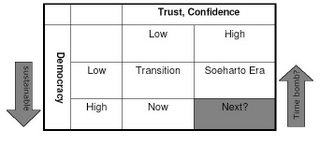
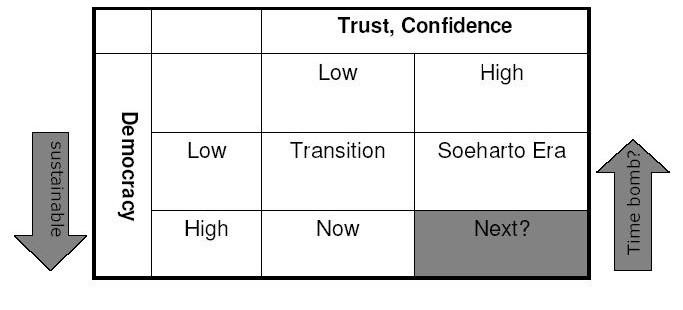
I looked at the history of Indonesia's aid dependency. The donors seemed to really believe in Soeharto's administration, despite the poor state of democracy (and for that matter, poor governance). As the regime collapsed in 1998, democracy movement was underway. But the trust seemed to vanish, as evidenced by increasing conditionalities. The challenge now, therefore, is to regain trust/confidence while keep pursuing on democracy. ("There's always a price for democracy").
 Challenges Ahead
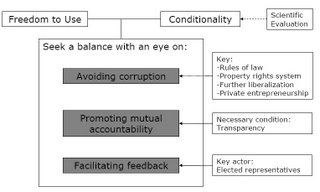
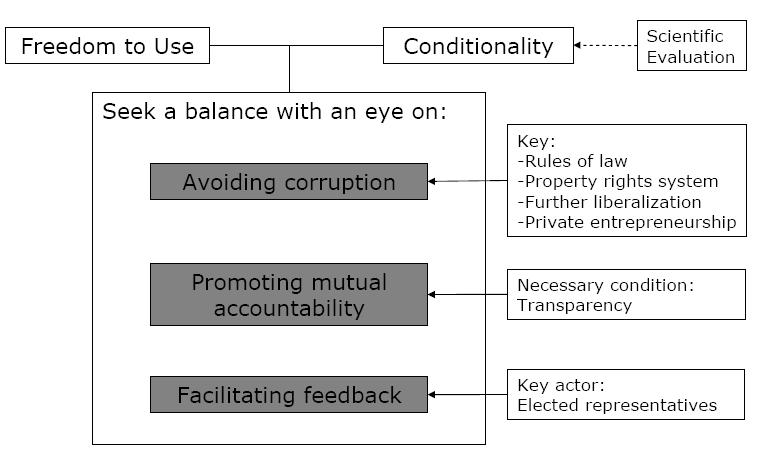
Which leads me to an apparent conflict of "freedom to use" aids and the attached conditionality on ODAs. We can't but to seek a balance, therefore:
The paper is still being refined. For complete powerpoint presentation, send me an email.
Facts
Indonesia is highly debt-dependent. The total debt amounted to USD 134 billions or almost 50% of GDP. The government debt constitutes almost 30% of the total debt, of which, 68% is in the form of Official Development Assistance (both bilateral and multilateral arrangement, in roughly similar weight). The ratio of government development expenditure over ODA in 2004 was 14%. This might be a new evidence against Pack and Pack (American Economic Review, 1990)'s conclusion that aid in Indonesia is not fungible. Of course, we need to realize that out of the total government expenditure, only 18% went to development expenditure (2004 data). For comparison, 17% went to interest payment and 23% went to subsidies (of which, 85% for fuel subsidy). Looking further to 2004 actual budget, it is disheartening indeed. As we know, the government ran a budget deficit of 1.3% of GDP. At the same time, 3.4% of GDP was used to finance subsidy, 2% to pay foreign debt amortization (gross drwaing was only 1% of GDP, resulting in a negative foreign financing), and 1% to redeem government bonds.
Donor-Recipient "Romance"?
I looked at the history of Indonesia's aid dependency. The donors seemed to really believe in Soeharto's administration, despite the poor state of democracy (and for that matter, poor governance). As the regime collapsed in 1998, democracy movement was underway. But the trust seemed to vanish, as evidenced by increasing conditionalities. The challenge now, therefore, is to regain trust/confidence while keep pursuing on democracy. ("There's always a price for democracy").
 Challenges Ahead
Which leads me to an apparent conflict of "freedom to use" aids and the attached conditionality on ODAs. We can't but to seek a balance, therefore:
The paper is still being refined. For complete powerpoint presentation, send me an email.
Thursday, April 20, 2006
The Politics of Sugar 1
This can go on and on and on. Now is sugar time.
Kompas reports the government has set a new "support price" for sugar. Read here (in Bahasa).
What is "support price"? It's just another form of protection given by the government to, well, support the price of a product. The idea is to "ensure that farmers receive a reasonable, fair price" -- just like Minister Pangestu claimed.
As the name suggests, support price is supposed to keep the price not to fall below a certain level. (Clearly for the benefits of producers and at the consumers' expense).
What happens if domestic production of a good increases? Well, naturally the price should go down. But the government and the producer don't like that. Hence the support price. What happens if domestic production stays constant or even decreases? Obviously, you don't need a support price. Or you can have one, but it will be useless, or ineffective.
But, surely an effective support price is an incentive for foreign production to enter the domestic market through import. How to "protect the domestic producers"? Impose import quota, or stronger yet, just impose a total ban on import.
Now the best part. What if the government sets a support price which is ineffective? "It's politics, stupid".
After all, the whole idea is to protect the sugar farmers (again, as the Minister claims). Now, the world market price is Rp 6,200 per kg, while the domestic support price Rp 4,800. If you really want to do farmers a favor, why not letting them enjoy that higher world price? But the government says, the buyers out there are ... evil (an evil who offers higher price?). Let's get back to this evil buyer issue later...
Kompas reports the government has set a new "support price" for sugar. Read here (in Bahasa).
What is "support price"? It's just another form of protection given by the government to, well, support the price of a product. The idea is to "ensure that farmers receive a reasonable, fair price" -- just like Minister Pangestu claimed.
As the name suggests, support price is supposed to keep the price not to fall below a certain level. (Clearly for the benefits of producers and at the consumers' expense).
What happens if domestic production of a good increases? Well, naturally the price should go down. But the government and the producer don't like that. Hence the support price. What happens if domestic production stays constant or even decreases? Obviously, you don't need a support price. Or you can have one, but it will be useless, or ineffective.
But, surely an effective support price is an incentive for foreign production to enter the domestic market through import. How to "protect the domestic producers"? Impose import quota, or stronger yet, just impose a total ban on import.
Now the best part. What if the government sets a support price which is ineffective? "It's politics, stupid".
After all, the whole idea is to protect the sugar farmers (again, as the Minister claims). Now, the world market price is Rp 6,200 per kg, while the domestic support price Rp 4,800. If you really want to do farmers a favor, why not letting them enjoy that higher world price? But the government says, the buyers out there are ... evil (an evil who offers higher price?). Let's get back to this evil buyer issue later...
The Politics of Fertilizer 1
"Government to ban fertilizer exports, permit some imports" is the head of this article from today's The Jakarta Post.
The natural question is: "Huh?"
Look one by one:
But how come the two come together as suggested by the headline? Which one is correct? What goes wrong? Of course your answer would be: "It's politics, stupid".
The natural question is: "Huh?"
Look one by one:
- Government to ban fertilizer exports. Why does it need to do this? Of course, if the policy is to be effective, the existing situation is such that the world price is higher than the domestic price. Otherwise, "banning export" doesn't make any sense, because after all, there is no incentive to export.
- Government to permit some imports. Why does it need to do this? Of course, if the policy is to be effective, the existing situation is such that the world price is lower than the domestic price. Otherwise, "permitting import" doesn't make sense, because after all, there is no incentive to import.
But how come the two come together as suggested by the headline? Which one is correct? What goes wrong? Of course your answer would be: "It's politics, stupid".
Monday, April 17, 2006
Thugs, thugs, everywhere
As I'm writing this, the online version of today's The Jakarta Post has not been updated. But go read the editorial of today's print. It is aptly titled "Thuggery as Law". What The Post means by thuggery is exactly what I refer to as the act of the "terminators".
Of worth-thinking, The Post says:
As I said earlier, I don't understand why the police are so ridiculed by these thugs. Now, almost every political party or organization has its own army of thugs. They are happy to terminate whatever they don't like.
And the government keeps silent. Where does our money go?
Of worth-thinking, The Post says:
In a confused libertarian society such as ours, lawlessness is glorified and agents of chaos knighted as persons of authority.Indeed.
As I said earlier, I don't understand why the police are so ridiculed by these thugs. Now, almost every political party or organization has its own army of thugs. They are happy to terminate whatever they don't like.
And the government keeps silent. Where does our money go?
Sunday, April 16, 2006
Yet another minor makeup
(Coerced) readers of Exegesis complained about my new skin. Rizal said: "Dude, I don't like your new skin". Patricia complained: "Too plain, too pale", Oki (Ki, set up yours, would you?) suggested: "Be a lil' more colorful". Ces Mad told me, "That's so not you: changing things up...". Thanks, guys. At least I know you come visit :-)
But, as I found out, part of your dissatisfaction came from your using Internet Explorer as your browser. Guys, that thing sucks! It shows things worse than they actually are. Change to Firefox!
Consumer is the king. So I have made a little makeover. Not too much. But I have put some pictures in the sidebar. I hope my cute-half doesn't mind my using our picture.
I confess, I have way more ideas to improve this blog than I can. Alas, I'm not a CS-HTML-and-all-that guy. Don't even think of "view page source" this site. It shows how novice I am. (It reminds me of my GAUSS programming days. It was exciting and embarrassing at the same time. Especially when my CS friend who is also an economist saw my 30-line code and he quickly suggested tranforming it into 10-something-line code!).
Update: When I said "consumer is king", I was in sarc mode. So Rizal, don't ask too much :-)
But, as I found out, part of your dissatisfaction came from your using Internet Explorer as your browser. Guys, that thing sucks! It shows things worse than they actually are. Change to Firefox!
Consumer is the king. So I have made a little makeover. Not too much. But I have put some pictures in the sidebar. I hope my cute-half doesn't mind my using our picture.
I confess, I have way more ideas to improve this blog than I can. Alas, I'm not a CS-HTML-and-all-that guy. Don't even think of "view page source" this site. It shows how novice I am. (It reminds me of my GAUSS programming days. It was exciting and embarrassing at the same time. Especially when my CS friend who is also an economist saw my 30-line code and he quickly suggested tranforming it into 10-something-line code!).
Update: When I said "consumer is king", I was in sarc mode. So Rizal, don't ask too much :-)
Thursday, April 13, 2006
Supercops Terminators
That's it. These guys just never get it. It amazes me how they are free to do this over and over again. I have no problem with their burning any magazine, as long as they buy it first. For crying outloud! Look, the man says:
We have reported the chief editor of the magazine, the models, journalist, photographers and 26 companies that have placed advertisement in the magazine to the police.Yeah right and yet you go on with your usual brutality, ignoring whatever the police says. Who needs police if you heroes exist?
Tuesday, April 11, 2006
The Selfish Labor
No, there's nothing wrong with being selfish.
But calling your selfish act as social in the name of the people is dishonest and misleading. I'm talking about workers that protest the revision of Indonesian 2003 Labor Law. Central in their rallies is the fallacy that protecting their rights is good for the whole country. I say bull. It's good for them employed workers only. (And that means just those working in the formal sector). It's obviously a barrier to informal workers and unemployment in general. There's nothing wrong with negotiation. But don't lie. If you are protecting 30 percent of the people at the expense of the other 70 percent, don't say you're protecting everybody.
Revise that law. Now.
Update: Rasyad A. Parinduri says it better.
But calling your selfish act as social in the name of the people is dishonest and misleading. I'm talking about workers that protest the revision of Indonesian 2003 Labor Law. Central in their rallies is the fallacy that protecting their rights is good for the whole country. I say bull. It's good for them employed workers only. (And that means just those working in the formal sector). It's obviously a barrier to informal workers and unemployment in general. There's nothing wrong with negotiation. But don't lie. If you are protecting 30 percent of the people at the expense of the other 70 percent, don't say you're protecting everybody.
Revise that law. Now.
Update: Rasyad A. Parinduri says it better.
Thursday, April 06, 2006
Great disruption
Together with Mochtar Pabottingi of LIPI (Indonesian Institute of Sciences), I gave a talk on Fukuyama's Great Disruption at Freedom Institute. (It's not really a new book, but Freedom has just published the Indonesian edition -- an appreciated effort). Here's what I said, more or less:
Summary
Social capital is “a set of informal values or norms shared among members of a group that permits cooperation among them. If members of the group come to expect that others will behave reliably and honestly, they will come to trust one another”. Social capital (in the
To elaborate on the views on “the contradiction of capitalism”, FF refers to sources like Edmund Burke (who blamed French Revolution and Enlightenment Era for the GD), John Gray (who blamed the fall of the Berlin Wall), Fred Hirsch (who blamed growth), and even goes further to Schumpeter, Daniel Bell etc (for possible conflict between market and social order). Thank God, FF doesn’t buy all this stuff – at least not all. In fact, he says those arguments are not even-handed. He then balances the literature with the likes of Montesquieu, Samuel Ricard, and Adam Smith (rightly, FF uses “The Theory of Moral Sentiments” rather than “The Wealth of Nations”) who argued, among all, that trade is good for developing social capital.
Where FF stands
FF stands quite on the center. But not exactly. Note, for example, he says that the view that social capital belongs to the society is wrong. It is produced by private market. Being honest, trusted and all that is every firm’s way of maximizing its profit, not because it is concerned with the society (pg 314 of Indonesian edition). It’s not surprising. Had he been more in-depth on Hayek, he might not even need to write this book. A point that leads us to “spontaneous order”. “Slug” is definitely a spontaneous order. (Did I just reveal where I am in FF’s Figure 8.4?).
This book is confusingly ambiguous. You can easily find contradictions here and there (and you are asking yourself: Is this really that famous
I propose Sobel’s 2002 JEL paper definition: “Social capital describes circumstances in which individuals can use membership in groups and networks to secure benefits”. It is drawn from Pierre Bordieau (1986): “Social capital is an attribute of an individual in a social context. One can acquire social capital through purposeful actions and can transform social capital into conventional economic gains”. Obviously FF’s argument is not unique. Putnam (1995, 2000, “Bowling Alone”) has similar view, that, as summed by Sobel, “a dramatic decline in the level of participation in group activities” threatens the quality of democracy and the quality of life. He lists some negative effects e.g. destabilizing democratic institution, lowering schools effectiveness, etc. In short, Putnam’s view is pretty heroic. And Sobel attacks all that. If I were to review FF, I’d save time by suggesting people to read Sobel’s review on Putnam. The tone would be the same. Because GD is just another way to lay out Bowling Alone all over again. FF is Putnam. They both argue that, again borrowing Sobel’s sentence, “measurable declines in group activities cause bad outcomes”. As for me, SC is just a possible consequence of human action in his or her society. When it’s beneficial for him/her to engage with other people, vice verse, then SC is developed.
Just like Nicholas Lemann (1996, “Kicking in Groups”) who offered countertrends such as small business and restaurants, I would like to offer the … blogosphere. If Putnams says “You can’t make friends using telephones; but you can use the phone to maintain friendships”, I’d suggest him to go look Friendster. If you can measure somebody’s social capital by looking at the size of his Rolodex, why don’t you want to look at somebody’s circle of friends in his Friendster?
Tuesday, April 04, 2006
Can a scientist be wasted?
My brother-in-law works for the Tokyo-based NSK Ltd. He went to Tokyo Institute of Technology and got his PhD in "impact energy absorption technology" -- I have no idea what that is. Having earned his degree, he went home, trying to find a job. He couldn't find any that matched with his qualification. He even visited ITB (Bandung Institute of Technology) only to find that the Institute doesn't have a course of his specialization. He did pursue academic career further, but he likes "to apply it in a real life".
So he went back to Japan. Now he's busy with NSK's R&D Dept, researching "crashworthiness" -- again I don't know what that thing is. Despite his constant urge to come back home and work in Indonesia, he lives a happy life with his family in Tokyo. As I can tell from my sister's stories.
Why am I telling this? Kompas today runs this headline, saying that Indonesian scientists' talent and skill are wasted. The article blames the country's lack of "grand strategy" to develop science and technology and of good long-run program of human resource development.
I know what it means. But I don't think scientists can be a waste. If you can't "use" them, somebody else would.
So he went back to Japan. Now he's busy with NSK's R&D Dept, researching "crashworthiness" -- again I don't know what that thing is. Despite his constant urge to come back home and work in Indonesia, he lives a happy life with his family in Tokyo. As I can tell from my sister's stories.
Why am I telling this? Kompas today runs this headline, saying that Indonesian scientists' talent and skill are wasted. The article blames the country's lack of "grand strategy" to develop science and technology and of good long-run program of human resource development.
I know what it means. But I don't think scientists can be a waste. If you can't "use" them, somebody else would.
Monday, April 03, 2006
Greg Mankiw's Blog
It's always a good thing when a professional economist comes back. The blogosphere welcomes Greg Mankiw. Yes, it's *the* Mankiw.
Via Arnold Kling.
Via Arnold Kling.
Sunday, April 02, 2006
Labor IS a factor of production
SBY seems to have missed his Solow chapter on growth. While he's correct that "real wage should equal productivity", he insists that "labor shouldn't be treated just as a factor of production". How not so?
Read here (Bahasa Indonesia).
Read here (Bahasa Indonesia).
Friday, March 31, 2006
Corruption at the United Nations?
A recent paper by Harvard's Ilyana Kuziemko and Eric Werker uncovers the likely corruption at the United Nations. Furthermore, it's likely that the UNICEF should be hold responsible the most; and that means... the U.S. Abstract:
via MarginalRevolution.
Ten of the fifteen seats on the U.N. Security Council are held by rotating members serving two-year terms. Using country-level panel data, we find that a country’s foreign aid receipts rise substantially when it is elected to the Security Council: on average, U.S. aid increases by 54 percent and U.N. development aid rises by 7 percent. We find that the positive effect of Security Council membership on aid is much greater during years in which key diplomatic events take place, when members’ votes are likely to be especially valuable. Further, the increase in aid is shown to begin the year a country is elected to the council and to disappear after its membership ends. We find evidence that the effect of council membership on U.S. aid is especially large for dictatorships and U.S. allies, suggesting that the United States seeks to form alliances with the council members who are cheapest to bribe. Finally, the connection between U.N. aid and council membership seems to be driven by UNICEF, an aid organization over which the United States has historically exerted much control.It's really everywhere.
via MarginalRevolution.
Thursday, March 30, 2006
Unique, exclusive identity: (im)possible?
I agree with Amartya Sen:
Limiting a given individual's identity to a unique and exclusive association may disadvantage both the individual and the institution he or she is associated with.
When somebody commits terrorism and it turns out he or she is a Muslim, reductionists conclude: Islam is bad. This is an example of how an institution is disadvantaged by a unique, exclusive identity association.
As for how the effect harms the other way, think about the stigma from which Islam now has to suffer, thanks to reductionist way of thinking. Somehow every muslim is a terrorist.
Of course it is easy to find examples showing that the effect can be good. Sen uses Al-Ikhwarizmi as an example. He's a great mathematician and he's a muslim. I can't blame muslims who are proud of this. But saying that every muslim is a good mathematician is simply wrong, no matter how good it sounds.
"...A person's religion need not be his or her all-encompassing and exclusive identity. Islam, as a religion, does not obliterate responsible choice for Muslims in many spheres of life. Indeed, it is possible for one Muslim to take a confrontational view and another to be thoroughly tolerant of heterodoxy without either of them ceasing to be a Muslim for that reason alone..."Here's the article from Slate.com.
Limiting a given individual's identity to a unique and exclusive association may disadvantage both the individual and the institution he or she is associated with.
When somebody commits terrorism and it turns out he or she is a Muslim, reductionists conclude: Islam is bad. This is an example of how an institution is disadvantaged by a unique, exclusive identity association.
As for how the effect harms the other way, think about the stigma from which Islam now has to suffer, thanks to reductionist way of thinking. Somehow every muslim is a terrorist.
Of course it is easy to find examples showing that the effect can be good. Sen uses Al-Ikhwarizmi as an example. He's a great mathematician and he's a muslim. I can't blame muslims who are proud of this. But saying that every muslim is a good mathematician is simply wrong, no matter how good it sounds.
Monday, March 27, 2006
U.S. support of Israel was and is a bad idea
The U.S. support for Israel should be eliminated. The U.S. shouldn't even have helped the creation of Israel in the first place.
The above paragraph isn't mine. I borrow it from a U.S. libertarian economist, Jeff Myron. Prof. Myron cites a controversial paper by Chicago's J. Mearsheimer and Harvard's S. Walt. The first sentence is drawn from the study, and the second is Myron's.
Here is the complete paper, and below is its abstract:
The above paragraph isn't mine. I borrow it from a U.S. libertarian economist, Jeff Myron. Prof. Myron cites a controversial paper by Chicago's J. Mearsheimer and Harvard's S. Walt. The first sentence is drawn from the study, and the second is Myron's.
Here is the complete paper, and below is its abstract:
In this paper, John J. Mearsheimer of the University of Chicago's Department of Political Science and Stephen M.Walt of Harvard University's Kennedy School of Government contend that the centerpiece of U.S. Middle East policy is its intimate relationship with Israel. The authors argue that although often justified as reflecting shared strategic interests or compelling moral imperatives, the U.S. commitment to Israel is due primarily to the activities of the “Israel Lobby." This paper goes on to describe the various activities that pro-Israel groups have undertaken in order to shift U.S. foreign policy in a pro-Israel direction.
Subscribe to:
Posts (Atom)