Over at a discussion on JBIC's new survey results on Japanese companies' perception on Indonesia as future production base in the region, a debate arose around the poor infrastructure condition. A spokesperson from East Jakarta Industrial Park blamed the government for not giving priority to improve the road condition to facilitate better logistics from industrial park to the port. The government's national planning bureau (Bappenas) denounced the charge, saying that they did have "concrete plans" (what's "concrete plans"?) to develop better access from the park to the port. However, when they were about to implement the plan, they found out that the state-owned company responsible for managing toll roads, PT Jasa Marga had already have a contract plan with some private companies. So --bear with me-- the Bappenas could do nothing about it. As to why even the Jasa Marga had not realized the plan was a mystery to the audience. We only knew that, given all the "concrete plans" they have, the government officials seem to value grandiose, ivory-tower event like the Asian-African Summit highly above infrastructure improvement. In fact, a source told me that the money had been rerouted to develop the new toll road to serve the summit's VIPs. Yes, the new toll road now also serves commuters from Jakarta to Bandung (or the other way around), but at the same time it creates severe bottleneck for the flow of export goods coming from Cibitung, Cikarang, Kerawang, and Cikampek (the industrial parks) to Tanjung Priok (the shipping port). [One of ongoing research in LPEM now is to identify logistics inefficeincy in export industries. Surely, this would be a very important issue].
But, continuing on my frustation yesterday, it simply appears to me that the government really has coordination problem. Mind you, Bappenas is government. Jasa Marga is state-owned. Sounds familiar?
Friday, June 24, 2005


Wednesday, June 22, 2005
Coordination razzle-dazle: oil
Pick any national newspaper these days. They all talk about the happening oil crisis in Indonesia -- once known as an oil exporter. We knew it's coming and we would have suggested higher price to help anticipate that. But that's aside for now (calm down!).
What really bothers me from all the news is the mess in coordination. The state-owned oil company, Pertamina blames it on the government, and the government via the Ministry of Finance fires back to Pertamina. In the meantime, the state-owned energy company, PLN blames the government for not backing them up when they are short to pay the supply from Pertamina. Pertamina refuses to supply since it is not "appropriately subsidized" by the government. The Minister of State-Owned Enterprises seem confused. And there comes Pertamina-Exxon dispute. Cepu is supposed to produce one tenth of the national oil output. That's a lot, especially in these tough days. But the government seems lame in solving the dispute.
What in the world is going on? Do we not have that function we usually call "coordinating" minister? If the government really can't manage itself, isn't it a justification for more privatization? (Oh by the way, I was told, the coord-min wants privatization; it's only that, some ministers are strongly against it).
And, to add to my frustation: Speaking about oil, this is a piece (in Bahasa) by an adventurous politician sometimes calling himself an economist (I was a big fan of his writings -- not anymore after his pieces like this and this) and now trying to wash his dirty hands, using angelical words. I'm disgusted.
What really bothers me from all the news is the mess in coordination. The state-owned oil company, Pertamina blames it on the government, and the government via the Ministry of Finance fires back to Pertamina. In the meantime, the state-owned energy company, PLN blames the government for not backing them up when they are short to pay the supply from Pertamina. Pertamina refuses to supply since it is not "appropriately subsidized" by the government. The Minister of State-Owned Enterprises seem confused. And there comes Pertamina-Exxon dispute. Cepu is supposed to produce one tenth of the national oil output. That's a lot, especially in these tough days. But the government seems lame in solving the dispute.
What in the world is going on? Do we not have that function we usually call "coordinating" minister? If the government really can't manage itself, isn't it a justification for more privatization? (Oh by the way, I was told, the coord-min wants privatization; it's only that, some ministers are strongly against it).
And, to add to my frustation: Speaking about oil, this is a piece (in Bahasa) by an adventurous politician sometimes calling himself an economist (I was a big fan of his writings -- not anymore after his pieces like this and this) and now trying to wash his dirty hands, using angelical words. I'm disgusted.
Friday, June 17, 2005
Fine survey, poor inference
In a seminar on decentralization yesterday, a team from the World Bank presented their survey result done with Gajah Mada University. The "most comprehensive study of the impact of decentralization on the quality of public service to date" concluded that "autonomy leads to improved public services". Well...
I'm not against decentralization. In fact, I like the idea of decentralization. But I have problem with the inference drawn by the research team -- or rather, on the way the team drew their conclusion. Look at their questionnaire here. One question to -- supposedly -- capture households' perception on decentralization, i.e. "local autonomy" is
Now, from that kind of question, do you dare to make an inference about the effect of autonomy on public services? I would not.
Try another one:
Again, can this kind of question lead you to conclude that the autonomy or decentralization lead to improvement or disimprovement?
Probably yes, if you can find some way to isolate any possible other factors that might determine the change in "poor people empowering" etc. Just because many respondents said that "poor people empoering" is "increasing" is no justification to conclude that it was due to autonomy policy or decentralization, even though you picked up the relevant periods of time.
This is the same with the former question above. Just because majority of respondents said that the school quality is better in 2001 compared to 2000, you can't just conclude that it was because the autonomy/decentralization.
All that was presented yesterday was data frequency and percentages. No parametric treatment whatsoever. So, I was very surprised with such a strong conclusion.
It strikes me that people can rush to make inference that way. That is a dangerous approach to data.
I'm not against decentralization. In fact, I like the idea of decentralization. But I have problem with the inference drawn by the research team -- or rather, on the way the team drew their conclusion. Look at their questionnaire here. One question to -- supposedly -- capture households' perception on decentralization, i.e. "local autonomy" is
"Local economy is currently undergoing since 2001. In your opinion, how is the quality service [sic] of [...] in the district/municipality compare to year 2000?" The items for [...] are school, puskemas (health clinic, head of village, sub-district office, and district/municipality office. The options for responses are 1) Worse, 2) Same, 3) Better, and 4) Don't know.
Now, from that kind of question, do you dare to make an inference about the effect of autonomy on public services? I would not.
Try another one:
"In you opinion, how is the quality of [...] program implementation in this district/municipality in 2001 compare with [sic!] year 2000?" The items include for example "poor people empowering" and the response options are 1) Decreasing, 2) Constant, 3) Increasing, and 4) Don't know.
Again, can this kind of question lead you to conclude that the autonomy or decentralization lead to improvement or disimprovement?
Probably yes, if you can find some way to isolate any possible other factors that might determine the change in "poor people empowering" etc. Just because many respondents said that "poor people empoering" is "increasing" is no justification to conclude that it was due to autonomy policy or decentralization, even though you picked up the relevant periods of time.
This is the same with the former question above. Just because majority of respondents said that the school quality is better in 2001 compared to 2000, you can't just conclude that it was because the autonomy/decentralization.
All that was presented yesterday was data frequency and percentages. No parametric treatment whatsoever. So, I was very surprised with such a strong conclusion.
It strikes me that people can rush to make inference that way. That is a dangerous approach to data.
Thursday, June 16, 2005
Credit, motorcyle, and interest rate
It's always good to talk with those really engaged in the ups and downs of the economy. At least two challenging issues I gathered from a friendly talk with Kim Eng Securities analysts. First, with regards to the decreasing role of private consumption in the total economic growth of 1Q05; I was offered insightful theory. That there's a changing consumer behavior triggered by extremely easy credit scheme for motorcycles. Average lower income household has a takehome pay for about Rp 1 million a month (USD 105). The easy credit tempts many of such household to buy motorcycles. They end up paying Rp 5oo,000 to Rp 600,000 (USD 53-63) each month. The leftover is really small, compared to the time where motorcycle credit is unaffordable. Hence the low private consumption number. I would add that the recent plan of Jakarta governor to develop special paths for motorcyclists in the city of Jakarta will contribute further to the skyrocketting of motorcycle sales. (My related post on this motorcycle credit, here).
Secondly, still related to that easy credit. It seems to my friends that interest rate really does not matter to the motorcycles buyers. They just require a credit scheme -- no matter how high or low the interest rate is. This is worth investigating. Since, "it is possible that the credit scheme is not a function of interest rate anymore -- it is the other way around!". This is really intriguing as well as challenging. If I have time and data, I'd love to test this hypothesis. (Students: want a good topic for thesis?)
Secondly, still related to that easy credit. It seems to my friends that interest rate really does not matter to the motorcycles buyers. They just require a credit scheme -- no matter how high or low the interest rate is. This is worth investigating. Since, "it is possible that the credit scheme is not a function of interest rate anymore -- it is the other way around!". This is really intriguing as well as challenging. If I have time and data, I'd love to test this hypothesis. (Students: want a good topic for thesis?)
Thursday, June 09, 2005
Old Soldier Strikes Again
Friedman -- THE Friedman, and that means: Milton -- strikes again. He calls for legalizing marijuana (i.e. replacing prohibition with taxation). Here's the story. Here's the list of signatories of a petition led by Friedman -- unlike what the story tells, not all of them are distinguished economists. Only a handful, of which Friedman of course stands out. Talking about this guy, he's just been interviewed here (via MR).
(Somehow I remember my wild idea last year to legalize the now-illegal logging using a strongly enforced tax mechanism)
(Somehow I remember my wild idea last year to legalize the now-illegal logging using a strongly enforced tax mechanism)
Monday, June 06, 2005
Freakonomist Has New Column
Recommended new column: Freakonomics goes to NYT. Here's the debut. How can you not like a reading like this:
"Chen is a hyperverbal, sharp-dressing 29-year-old with spiky hair. The son of Chinese immigrants, he had an itinerant upbringing in the rural Midwest. As a Stanford undergraduate, he was a de facto Marxist before being seduced, quite accidentally, by economics. He may be the only economist conducting monkey experiments..."
Friday, June 03, 2005
May's Inflation is Even Lower
BPS Press Release says:
Meanwhile, some economists claim that BPS growth report is misleading. Since "it does not take unemployment into account" and "the fact is, consumption has been decreasing; why would then we have high growth?". Since when, we put un-employment into growth accounting? Since when, GDP is just consumption?
"May 2003, was marked with 0.21 per cent of inflation. Based on the Consumer Price Index (CPI) calculation in 43 cities, inflation was experienced in 30 cities, while deflation happened in 13 cities. The highest inflation was in Palu (2.31 per cent), whilst the lowest inflation was in Palangkaraya (0.01 per cent). Meanwhile, the biggest deflation was experienced in Padang Sidempuan (-1.09 per cent) and the smallest inflation happened in Bandung and Purwokerto (-0.04 per cent). The inflation was contributed by the increase in the prices of some goods and services groups as follows: prepared food, beverages, and tobacco products (0.01 per cent), housing (0.76 per cent), clothing (0.35 per cent), health (0.81 per cent), education, recreation and sports remained stable (0.00 per cent) and transportation & communication (0.03 per cent). Meanwile, unprepared food experienced a decrease as high as minus 0.28 per cent".So, what do you say about the "terrifying impact of BBM price hike on inflation rate" now?
Meanwhile, some economists claim that BPS growth report is misleading. Since "it does not take unemployment into account" and "the fact is, consumption has been decreasing; why would then we have high growth?". Since when, we put un-employment into growth accounting? Since when, GDP is just consumption?
Wednesday, June 01, 2005
NR&Env Econ Exam
Technical Note: A friend who uses Internet Explorer told me that this post had weird notation. It was meant to be a footnote. I work with Mozilla Firefox and I don't see weird stuff coming out from my footnote numbering. But, as many of you still use IE, I now have "fixed" the problem by changing the number into an asterisk. My suggestion, however, STOP USING INTERNET EXPLORER! GET MOZILLA!
The Natural Resource and Environment Economics, final exam last week. This is somewhat a watered-down version of the mid-term --which turned out not to be very rewarding.
The Natural Resource and Environment Economics, final exam last week. This is somewhat a watered-down version of the mid-term --which turned out not to be very rewarding.
- What do we mean by efficient allocation of scarce water? Do you think we in
- What do you think of the “Global Scarcity Hypothesis”? Does it make sense? Why or why not?
- Should we privatize our forests? Why or why not? (For either case, please provide an economic argument, not a romantic one *).
- Explain again, why maximum sustainable yield can be a bad target for fish catching if the objective is to conserve the fish?
- Give me one reason why the government should intervene in supplying water. Elaborate on that. If you don’t think there is any single reason, argue.
Wednesday, May 25, 2005
Second best: corrupt fundamental
These many days media have been flooded by news on corruption. Opinions and editorials have follow suit. And now the president, out of desperation, again calls for religious teachings for combating the corruptive mentality.
But will these all work? Looking at the chronic situation in Indonesia, I sadly see no prospects. Corruption is already a culture. It's ubiquitous.
While, to add to that pain, we've got little money and resources left. Yet, we've got to grow.
Now, I could start understand the points made by Avinash Dixit in his "Lawlessness and Economics". In short, you can't wait until the coast is really clear. You have to be able to develop and to grow on a ... corrupt fundamentals.
But will these all work? Looking at the chronic situation in Indonesia, I sadly see no prospects. Corruption is already a culture. It's ubiquitous.
While, to add to that pain, we've got little money and resources left. Yet, we've got to grow.
Now, I could start understand the points made by Avinash Dixit in his "Lawlessness and Economics". In short, you can't wait until the coast is really clear. You have to be able to develop and to grow on a ... corrupt fundamentals.
Tuesday, May 17, 2005
I'm back -- I'm trying!
One month of blogless day. What am I, a Robinson Crusoe?. I confess I've got no time to write. There's been a major change in the board of management in my office. I have been busy -- I should be busy.
Here are some things that I would have blogged within last month:
1. My pick for Alan Greenspan's successor: Ben Bernanke.
2. Daron Acemoglu deserves John Bates Clark Medal.
3. The economics rationale of getting married. Oh by the way, this is another reason why I have been absent for awhile.
Here are some things that I would have blogged within last month:
1. My pick for Alan Greenspan's successor: Ben Bernanke.
2. Daron Acemoglu deserves John Bates Clark Medal.
3. The economics rationale of getting married. Oh by the way, this is another reason why I have been absent for awhile.
Monday, April 18, 2005
Quality OK, Delivery No
Last week Faisal Basri and I joined a team visiting four export-oriented factories. It seems to me that our low competitiveness is not due to bad quality, nor it is on technology. It is because inefficiency in delivery. Among all, the most problematic culprit is transportation infrastructure. The trucks with containers from these factories have to waste several hours every day dealing with traffic jam and long queues in toll way gates and port gate. Once they enter the port, they have to fill in several documents, many of which are not required by laws, but by "convention". In addition, the corporate income tax return takes so long a time it hinders the cash flows of those firms.
Friday, April 08, 2005
Is potato Giffen?
Samuelson says yes.
Varian doubts it ("Samuelson reads too much Marx").
Statsny says it depends.
Rosen writes in JPE.
I'd say just call the whole thing off.
Varian doubts it ("Samuelson reads too much Marx").
Statsny says it depends.
Rosen writes in JPE.
I'd say just call the whole thing off.
Thursday, April 07, 2005
Freakonomics
The blogosphere welcomes Steven D. Levitt who is named "the most brilliant young economist in America" by the New York Times. [via Marginal Revolution].
Friday, April 01, 2005
Klein answers Thaler-Sunstein
As you might have noticed, I mentioned the Thaler-Sunstein "theory" on "libertarian paternalism" many times already (here and here are examples). I think it's a good paper, but at the same time, the term "libertarian paternalism" sounds like an oxymoron -- even though Thaler and Sunstein denounce it. Now comes a rebuttal from Daniel Klein. Klein accuses Thaler and Sunstein to confuse the terms libertarianism and paternalism (and the "oxymoronic gimmick", henceforth) with benevolence. The dessert placement in TS paper, arues Klein, has nothing to do with libertarianism or paternalism -- it is a mere benevolence. Klein goes on to take Thaler-Sunstein way of argument so as to fit with whatever: libertarian socialism, libertarian communism, libertarian dirigisme (sic!), or libertarian repression. To Klein, paternalism involves coercion. And that is where it is diametrical to libertarianism -- hence "libertarian paternalism" is non-existent.
My take: It is tempting to then replace the l-p with "benevolence" and that would fit the examples in T-S paper. But, I would have asked Klein, what should we call government planning endorsed by the house of representatives?
Looking forward to T-S's reply. Or better yet, some words from the rhetoric expert, Dee McCloskey.
My take: It is tempting to then replace the l-p with "benevolence" and that would fit the examples in T-S paper. But, I would have asked Klein, what should we call government planning endorsed by the house of representatives?
Looking forward to T-S's reply. Or better yet, some words from the rhetoric expert, Dee McCloskey.
Friday, March 25, 2005
If people just want to think
Why haven't I elaborated my thinking about the controversy surrounding the gas price hike, in this blog? Because it's near useless. Have tried to talked many times and have answered many questions. But only two or three persons are willing to listen. You go find any newspaper or simply open your newsgroups. People even make stupid jokes on the issue. One of them goes like this: "In order to reduce the number of the poor, raise the gas price". And the readers laugh cynically. Yes, those who got no intention to even think. Who are not even open to a possibility that the silly "joke" might be true. Try it: just add this condition: "... and transfer the money from the less-entitled rich to the more-entitled poor". See? I can understand people's sympathy to the poor. But I can't stand those who use them to gain popularity. Some of them claim to practice "economics for the people" (for lack of better translation); while they simply rephrase "Pancasila" here and there (no, not a bit of stuff like Amartya Sen's). If this is popularity contest, I'd switch the channel to Indonesian Idol.
This is getting pestiferous!
This is getting pestiferous!
Thursday, March 24, 2005
Midterm Exam: Environmental and Natural Resources Economics
- We have discussed about the two opposing views of the future: optimistic- and pessimistic models. Summarize their claims briefly. Since they talk about the future, we cannot satisfactorily decide which one is right now. (The “famous bet” between Ehrlich and Simon might just be a pure coincidence – well, it was a bet!). So, what criteria do you think we might propose for evaluating the predictions of the two views?
- Economists have been valuing the environment. Do you think it is ethical? Why or why not? Why do we need valuation? What are the limitations of environmental valuation methods offered by economists?
- Sustainable development is a matter of sharing costs and benefits between generations. True or false? Why? We don’t know what our grandkids really want, but we sometimes assume that they would like the forests to be preserved, instead of a huge shopping mall to replace the forest. Why do we do this kind of “paternalism”?
- One of the practical implementations of Coasian approach in environmental policy is marketable pollution permits. Do you believe market can take care of the environmental problems? Why? In case you do, tell me how. Another thing, is it ethical to look at the pollution as a factor of production? Give me your argument.
- In discussing the issue of population bomb, we talk about the economics of population control. Now tell me what you know about the economics of childbearing. Gary Becker says, children are durable goods. Maintaining them incurs costs and benefits. So, optimize! Comments?
- Read the small box in Tietenberg page 293. Yes, it’s about the “Harbor Gangs of Maine”. It seems to me that informal arrangement can be sufficient to ensure efficient harvesting. Am I right or wrong? Why?
- We have talked about environmental injustice. It is the condition where those who bear the negative externalities of environmental deterioration are also those who are poor. But hey, this is like what’s happening everywhere. Can you think of a rich community that is willing to bear the negative externalities? If you can imagine one, why do you think the relatively rich people want to do that?
Monday, March 07, 2005
Ticket for gas
My insightful sister was wondering. Why doesn't the government just sell tickets with different nominal values to the BBM consumers? Those with high income should buy one ticket 5 times as much as those with low income, for example. The problem with this type of mechanism is, as I told her, monitoring. Mr. Rich will ask Mr. Poor next door to buy tickets for him. With some incentives, Mr. Poor will do it happily. Moral hazard and adverse selection at play. (Still this is worth elaborating. After all, even the compensation mechanism offered by the government is not free from such problems).
Addendum:
My sister responded again:
To which I replied:
Addendum:
My sister responded again:
I got the point of difficulty in monitoring. In fact what I was particularly wondering is how to make people that use public transport, regardless of being poor or rich, pay bbm/liter less than those use private cars. The justification made is simply that people using public transport use up much less space of the road and do not get as much convenience as people using private vehicle. I am fully aware of the absurdity of effort to identify who the poor or rich are in Indonesia.I mentioned about ticketing for buses through which government gives subsidy to the public transport users, i.e: users buy bus tickets at Rp. X, then the bus operator can reimburse the tickets at Rp X+Y. ticketing system has been applied for KRL (have no info of how it works). Unfortunately, as you said, for ticketing, there is always an issue of ticket faking. Now, what about allocating oil stations for buses where oprators can get cheaper bbm?
And I told her, please keep stimulating such good ideas; and don't get tired by economists' skeptical starting points in looking at things -- they are skeptical.Nice thoughts. On your last question. We sure hope the bus drivers do not have some evil pact with some guy somewhere: fill up their tanks repeatedly, and go sell somewhere else at higher prices. Arbitrage at play.
BBM and sustainable development
Finally someone looks at the BBM fiasco from sustainable development perspective. Very well done, Bang. Thanks for educating that to public.That's an SMS I sent to this great person (I have no idea if this site is official or not) in response to his article today in Kompas.
Sunday, March 06, 2005
Libertarianism vs Conservatism
Mises Economic Blog brings this debate into the blogosphere. Agree with them, this is a must read. Beware, don't confuse liberalism and libertarianism. Also, keep in mind that American conservatism/libertarianism are different with those of Europeans. Especially when it comes to economics. Why is Friedman "conservative" but libertarianically opposes big government? Political Compass may have some answer -- think about "liberal conservative".
Somehow, I am relieved that I don't need to resort on either one. I have my own principle and so far so good.
Somehow, I am relieved that I don't need to resort on either one. I have my own principle and so far so good.
Friday, March 04, 2005
Malaysia, you're getting into my nerve!
Malaysia is off the line. Alright, on that illegal migrants thingy, the blame might be on us. But just because of that, doesn't mean you can annex my country! Get off!!
IMF is loosing its focus, too
Attending the IMF's presentation yesterday, I was amazed. It was supposed to be "The Role of IMF in the Globalization". As it turned out, it was simply a roadshow promoting their "new focus": poverty reduction. Say what? Are these guys now trying to takeover the job from its neighbour across the street?
Monday, February 21, 2005
Microeconomics 2
Started the new semester for Microeconomics 2 last week. It's supposed to be the second in a three-part series of microecon course for graduate students. As it turned out the syllabus I had prepared had many overlaps with that for Microeconomics 1 taught by my colleague, Arindra Zainal. So I made changes. The result is as follows:
I know this is unusual. As some have said: when it comes to HV and MC, it's an "either-or" thing -- you can't use both at the same time. Let's see how it plays out.
Having done the changes, I guess I would also adjust my Microeconomics 3 course next semester as to stress more on General Equilibrium and Welfare Economics and less on Game Theory and Uncertainty.
Texts: Hal Varian (HV) and Andreu Mas-Colell et al. (MC)
Coverage: Markets (Perfect, Monopoly, and Oligopoly), Uncertaity, and Game Theory.
Outline: 1) Overview/review (HV 1,26,27; MC 1, Math App), 2) Perfect Competition (HV 13, MC 10), 3) Monopoly (HV 14, MC 12), 4) Oligopoly (HV 16, MC 12), 5) Uncertainty (HV 11, MC 6), and 6) Game Theory (HV 15, MC 7,8,9).
I know this is unusual. As some have said: when it comes to HV and MC, it's an "either-or" thing -- you can't use both at the same time. Let's see how it plays out.
Having done the changes, I guess I would also adjust my Microeconomics 3 course next semester as to stress more on General Equilibrium and Welfare Economics and less on Game Theory and Uncertainty.
Wednesday, February 16, 2005
Limits to Rationality
Inasmuch I hate Limits to Growth, this one I love: Limits to Rationality. Sharla Stewart writes very eloquently on Richard Thaler, an avant garde behavioral economist at Chicago. Stewart quotes Thaler:
“most economists recognize that some of the people are not fully rational some of the time, and some of the time that matters.”On traditionalists view that rationals cancel out irrationals,
“The combination of free entry, unfettered competition, and free choice seems hard to quarrel with, [h]owever, if participants are not well-informed or highly motivated, then maximizing choice may not lead to the best possible outcome.”
Behavioralists disagree, arguing that bounded rationality does indeed bump the market’s invisible hand.Of course, Gary Becker slightly resists:
“While I believe there’s value in some areas of psychology, the focus is different...” “We’re interested in how groups respond.”To which Thaler comments:
"Division of labor strongly attenuates if not eliminates any effects caused by bounded rationality".
“Maybe Gary Becker sometimes confuses behavioral economics with psychology,” says Thaler. “Because behavioral economists think about markets all the time.”And yes, don't forget Thaler-Sunstein good paper, Libertarian Paternalism.
Monday, February 14, 2005
Sorry
Another good thing about blogging is you don't get fine if you break your promises. One day you have lots of stories to share and the next day you lose all the excitement. Well, that's normal in blogospehere. And that happens to me. My apologies, I am no longer bloggery about the tour of disparity.
I was busy completing research reports.
And in the meantime, was also busy trying to understand this man and this man (in Bahasa). And the men are no blogging!
I was busy completing research reports.
And in the meantime, was also busy trying to understand this man and this man (in Bahasa). And the men are no blogging!
Thursday, February 03, 2005
NR&Env Econ Course
I kicked-off a new course yesterday. It is called "Natural Resources and Environmental Economics". It is in introductory level. This is the description:
This is the outline:
This course is a blend of two parts, namely Environmental Economics and Natural Resource Economics, with more emphasis toward the former. The purpose of the course is to provide an overview of the principles of economics used to analyze environmental and natural resource problems. As of completing the course, students are expected to be able to assess environmental and natural resource problems with economics point of view and offer policy recommendation accordingly.
This is the outline:
1. Introduction (Tietenberg, Ch. 1,2,5,21,22,23,24 / Julian Simon vs. Paul Ehrlich – some clippings.) 2. Property Rights, Externalities, and Market Failure (Tietenberg, Ch. 4 / Coase, Ronald, 1960.Social Cost," JLE 3:1-44)
Tuesday, February 01, 2005
"Very Good News"...
... was the subject of a mail sent to me by the ever-inspiring John Braden. He wrote:
Dear Arianto:to which I replied:
Your dissertation was chosen as the most outstanding in our Department for 2004 and is being submitted to the AAEA national competition... Congratulations! I am honored to be associated with your work ...
John
Dear John:I am very grateful to receive this recognition. No doubt, I owe this to you. I don't think I could even graduate in time without your guidance. Thank you so much!Arianto
Much to catch up
Or, I might hesitantly call it "a tour of income disparity". Yes, I am back from a long trip to Dakar, Senegal. On the way back, I stayed one night in Dubai. Dakar-Dubai, hence the disparity. So what's the tale? Will elaborate later on -- have to catch up on tons of works. My Bloglines is fed up -- can't wait for a weekend. (By the way, these interesting blogs have joined my feeds: Graycells, Footnotes and Mahalanobis in addition to the formerly listed Dan Drezner and Matt Yglesias -- later will add them all to the sidebar, too. Ugh, another thing that I should mention: this latest post by Aria is wonderful).
Thursday, January 20, 2005
Light blogging, if any
Off to Dakar, Senegal tomorrow. Will come back in the 28th. If any, blogging will be light. In the meantime, here are fun stuff:
Tyler accuses Brad as an Austrian economist. Brad, of course, denounces it. But those who really are in Austrian school -- and who adore Mises more than Hayek, tell us that this cartoon now has a video version. Enjoy (or hate) it.
Tyler accuses Brad as an Austrian economist. Brad, of course, denounces it. But those who really are in Austrian school -- and who adore Mises more than Hayek, tell us that this cartoon now has a video version. Enjoy (or hate) it.
Tuesday, January 18, 2005
Paris Club communique
It reads as follows (my emphasis):
"During their meeting held on January 12, 2005, Paris Club creditors discussed the situation of the countries affected by the tsunami. Considering the exceptional scale and the devastating effects of this catastrophe, and in order to allow these countries to dedicate all available resources to address humanitarian and reconstruction needs, and in addition to the substantial commitments of their governments and citizens to provide assistance, they shared the view that, with immediate effect and consistent with the national laws of the creditor countries, they will not expect debt payments from affected countries that request such forbearance until the World Bank and the IMF have made a full assessment of their reconstruction and financing needs. In the light of that assessment, and in consultation with affected countries, Paris Club creditors will consider what further steps are necessary. The precise response to affected countries will be determined in the light of their individual requests taking into account the situation of each country."
Rizal Ramli made a point
Unusually, Rizal Ramli makes sense:
"IMF's expertise is in planning fiscal and monetary policies, not in assessing damages.... Couldn't we do the assessment?"Thank to Rizal for the pointer.
Monday, January 17, 2005
Mbak Ani's clear vision
Very well-written article, by the State Minister of National Planning (in Bahasa). She lays out the government plan in dealing with the tsunami's aftermath in three phases: emergency, rehabilitation, and reconstruction. She also clarifies some confusion (also in Bahasa, a piece by Prof. Sadli) regarding the aid inflows.
Friday, January 14, 2005
No to a foreign military base!
This whole debate around the presence of a thousand foreign troops in Aceh is missing the point.
The pros argue, the destroyed Aceh is a world's problem. It should not be collapsed into nationalism sentiment whatsoever. Aceh needs all kinds of help, including those from foreign militaries. (On the radio I heard this morning, somebody said even the help from satan should be welcome!). So there shouldn't be any deadlines for the presence of foreign troops in Aceh. On the other hand, the government has asked them to leave Aceh in three months. The government worries that the foreign troops could be harmed by the GAM separatists -- a very bad political statement.
Both sides of arguments don't make sense. While I tend to agree with the government decision, it should have given a more reasonable justification. And that would be, the possibility of international takeover of Aceh, which would very likely be led by the U.S. The U.S. once had bases in the Philippines' Subic and Clark for their operation in East Asian region. But they get kicked out in 1992. They need a replacement to "serve" the region -- they've been everywhere else. They have been trying hard to get another strategic location. Indonesia is very strategic geographically. And add to that, it is increasingly becoming international military interest ("terrorist-haven" as sometimes the western media picture it). So,? You do the math. (I suspect the government takes this seriously, but they just can't say it -- too sensitive an issue?)
Of course you might say, c'mon. Look at those massive aid coming in, much of which from the U.S. I know. Aid is one thing. Military takeover is another. This is not about stupid nationalism. But I'm skeptical with the U.S. move. Some of you argue, we cannot rely on our own government, so why don't we open the access to foreigners as wide as possible. True, our government is slow and lame. But letting more than a thousand foreign troops there is just thrilling to me (and I never trust Bush's words about peace. You see the evidence against him everywhere). I hope I am wrong. As a note, by the way, all we get so far from the debt negotiation is debt moratorium, not debt relief. What we they give us is time, not money. Please don't say we owe them a region.
Will the government decision harm the aid inflow? It might. But it's better than having Aceh replacing Clark/Subic. I agree with setting the timetable for the foreign troops (I think civilian volunteers are fine, though). But the government should find a way not to lie to the public of what it's concern really is. At the same time, the government should be more decisive in coordinating the aid allocation as well as the reconstruction projects. So far it seems so messy: who's in charge? Alwi Shihab, JK, SBY, or whom?
God, save this country.
Aside: Now some of you might think I'm for conspiracy theories based on my foregoing assertion. No, don't ever think I also believe that the tsunami is caused by American experimental bomb under the sea. No, I never buy such crap!
Addendum: Just heard it on the radio. Things are getting worse. Alwi Shihab literally said, this is about nationalism and dignity. "How can we stand being looked at as a country that always needs helps? It's a shame if we cannot manage it ourselves". My goodness, he had no idea what he was talking about. Or, maybe he did. He's just a lousy politician.
The pros argue, the destroyed Aceh is a world's problem. It should not be collapsed into nationalism sentiment whatsoever. Aceh needs all kinds of help, including those from foreign militaries. (On the radio I heard this morning, somebody said even the help from satan should be welcome!). So there shouldn't be any deadlines for the presence of foreign troops in Aceh. On the other hand, the government has asked them to leave Aceh in three months. The government worries that the foreign troops could be harmed by the GAM separatists -- a very bad political statement.
Both sides of arguments don't make sense. While I tend to agree with the government decision, it should have given a more reasonable justification. And that would be, the possibility of international takeover of Aceh, which would very likely be led by the U.S. The U.S. once had bases in the Philippines' Subic and Clark for their operation in East Asian region. But they get kicked out in 1992. They need a replacement to "serve" the region -- they've been everywhere else. They have been trying hard to get another strategic location. Indonesia is very strategic geographically. And add to that, it is increasingly becoming international military interest ("terrorist-haven" as sometimes the western media picture it). So,? You do the math. (I suspect the government takes this seriously, but they just can't say it -- too sensitive an issue?)
Of course you might say, c'mon. Look at those massive aid coming in, much of which from the U.S. I know. Aid is one thing. Military takeover is another. This is not about stupid nationalism. But I'm skeptical with the U.S. move. Some of you argue, we cannot rely on our own government, so why don't we open the access to foreigners as wide as possible. True, our government is slow and lame. But letting more than a thousand foreign troops there is just thrilling to me (and I never trust Bush's words about peace. You see the evidence against him everywhere). I hope I am wrong. As a note, by the way, all we get so far from the debt negotiation is debt moratorium, not debt relief. What we they give us is time, not money. Please don't say we owe them a region.
Will the government decision harm the aid inflow? It might. But it's better than having Aceh replacing Clark/Subic. I agree with setting the timetable for the foreign troops (I think civilian volunteers are fine, though). But the government should find a way not to lie to the public of what it's concern really is. At the same time, the government should be more decisive in coordinating the aid allocation as well as the reconstruction projects. So far it seems so messy: who's in charge? Alwi Shihab, JK, SBY, or whom?
God, save this country.
Aside: Now some of you might think I'm for conspiracy theories based on my foregoing assertion. No, don't ever think I also believe that the tsunami is caused by American experimental bomb under the sea. No, I never buy such crap!
Addendum: Just heard it on the radio. Things are getting worse. Alwi Shihab literally said, this is about nationalism and dignity. "How can we stand being looked at as a country that always needs helps? It's a shame if we cannot manage it ourselves". My goodness, he had no idea what he was talking about. Or, maybe he did. He's just a lousy politician.
Wednesday, January 12, 2005
The next Julian Simon
I confess I haven't read Huber and Mills' Bottomless Well. But thanks to Tyler Cowen at the Marginal Revolution, I now know what it is about (yes, I trust Tyler's reading). In Tyler's words:
Of course the above is hated by many environmentalists. Somehow this reminds me of the famous bet between Paul Erlich and Julian Simon.
1. The cost of energy as we use it has less and less to do with the cost of fuel. Increasingly, it depends instead on the cost of the hardware we use to refine and process the fuel. Thus, we are not witnessing the twilight of fuel.
2. "Waste" is virtuous. We use up most of our energy refining energy itself, and dumping waste energy in the process. The more such wasteful refining we do, the better things get all around. All this waste lets us do more life-arrirming thing better, more clearly, and more safely.
4. The competitive advantage in manufacturing is now swinging decisively back toward the United States...[information technologies]
6. The raw fuels are not running out. The faster we extract and burn them, the faster we find still more. Whatever it is that we so restlessly seek -- and it isn't in fact "energy" -- we will never run out. Energy supplies are infinite...
Of course the above is hated by many environmentalists. Somehow this reminds me of the famous bet between Paul Erlich and Julian Simon.
Tuesday, January 11, 2005
Monsanto-gate
Monsanto has been bribing Indonesian top officials and their family. The Jakarta Post reported:
I guess this would either a) send some vip's to jail or b) just vanish in the air."... People from Monsanto met with a senior environment ministry official on several occasions.
... an employee of the consulting firm which represented Monsanto visited the senior official at his home and gave him an envelope containing $50,000 in $100 bills.
... Monsanto made at least $700,000 in illicit payments to at least 140 current and former Indonesian government officials and their family members.
... The largest single set of payments was for the purchase of land and the design and construction of a house in the name of a wife of a senior Ministry of Agriculture official, which cost Monsanto $373,990.
... Other improper payments included, among others, payments to a senior official of Budget Allocations at the National Planning and Development Agency (Bappenas), totaling $86,690, and payments to other Ministry of Agriculture officials, totaling $8,100.
... Officials of the South Sulawesi office of the agriculture ministry also received approximately $29,500 from Monsanto.
RIP: Robert Heilbroner
The author of the ever-illuminating Worldly Philosophers, Robert Heilbroner died today in New York. Another great loss.
Monday, January 10, 2005
Early warning system
I agree with Posner, we should build one:
"...[P]oor countries may not have the resources to create tsunami warning systems or take other precautionary measures that wealthy countries could afford to do. I would rephrase the point as follows: the budget for disaster prevention will depend on the competing claims on public and private funds. The more urgent those competing claims, the rationally smaller will be the budget devoted to disaster prevention..."
"...But to keep matters in perspective, although per capita incomes in the nations affected by the recent Indian Ocean tsunami are roughly 10 times less than the per capita income of the United States, the four countries principally affected--Indonesia, Thailand, India, and Sri Lanka, have an aggregate GDP of hundreds of billions of dollars. A tsunami warning system might cost only a few million dollars a year..."
Friday, January 07, 2005
Thursday, January 06, 2005
Moratorium or relief or what?
My two-cent op for those debating on debt moratorium:
1). Debt moratorium is not the same as debt relief. The former is temporary suspension, and the latter is permanent reduction/deletion or simply rescheduling.
2). G2G-based moratorium for official debts is very possible. But only for those under bilateral agreement. Those signed under the Paris Club are subject to discussion -- and a tough one, most likely. In the meantime, debt relief is still possible but less likely (unless Indonesia poses similar importance to donors the way Mexico was to the U.S. back in the Clinton years).
3). It's almost impossible to get relief (not to mention moratorium) for commercial debts. After all, corporations are no charity. (They will donate some money of course, for image-building).
4). So what now? Here's what I would suggest : 1) Demand debt relief (as so promised by U.K., Italy, and Belgium) -- I could imagine this would be relatively more manageable for bilateral agreements. But it would be extremely tough for multilateral: Paris Club is a cartel and the brain-child of the IMF; remember GOI has said no to the Fund; hence no more Paris Club dinners, 2) Demand debt moratorium (from Germany, U.S., Japan, Canada, and France).
5) If you are concerned with our rating, points in # 4 above will not hurt (read S&P Bulletin today) insofar the debts we are talking about are official debts. When it comes to commercial debts though, things are not pretty (see # 3, and in addition, unlike the case of official debts, this one is subject to lowered rating).
6) Yet, some would understandably cry out: why oh why are we still talking about the damn ratings in the midst of this sad sad sad catastrophe? Well, because those herds called Corporations out there always wake up in the morning and look at the S&P ratings before deciding where to put money today. And the thing is, it's commercial debts that are more volatile. Unfortunately, we are not sure if can play the Mexican way...
Tsunami's impact

Tsunami's impact (source: Citigroup: Hanna et al, 2005)

The above graph (click to enlarge) shows that the impact of the recent Tsunami on financial markets is not gigantic. (Thanks to Anton Gunawan for the article).
On the economics of the Tsunami see the interesting discussion of Posner and Becker today. They both agree that despite the great uncertainty of such catastrophe, a good early warning system should be provided. Becker goes on to offer solutions. In the long run: invest on education; and in the shorter run: good access to market insurance. But, as Becker admits, these both are not easy to do, especially by low income countries. And of course, moral hazard problem. See a rejoinder by Lynne Kiesling.
My take: Yes, the economic costs of the Aceh's Tsunami might not be gigantic. However, this event requires extremely careful response from the government. Yes, we expect (and have been promised) huge amount of foreign aid. Both in the form of grant or of debt forgiveness. Good diplomacy is crucial, because no such thing as a free lunch (recall: Rubin-Summers-Greenspan's unpopular determination to help Mexico in the Clinton years)
Tuesday, January 04, 2005
Education: basic first!
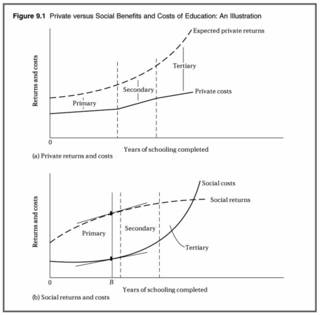
Returns to and costs of education (graph by Todaro)
Over examining a doctoral dissertation, a collegue and I were involved in a discussion. The examinee modeled public education provision and how it affects (or affected by) interregional movement of students. One of the results seems to imply that higher education should be centralized. Despite the fact that the dissertation treats education as consumption-only, not an investment (one serious weakness, I think), the collegue rightly argued that it is the basic education that needs centralization more than higher education. He backed up his argument with G. Psacharopoulos' finding that the returns to investment on basic education is greater than that on higher education. The referred study is a classic, and the finding seems to be a stylized fact these days (Psacharopoulos has updated again the paper in Education Economics, 12(2) Aug 2004 -- subscription required). I would have stated my agreement with him.
But instead, I misunderstood my collegue's point, and rather, raised another related point, namely: the the social returns to investment on higher education is lower than its private returns. Of course I had in mind the graph above (from the Mike Todaro's Economic Development that in turns also cites Psacharopoulos). In particular, what I really meant was that in the case of higher education, the net private returns exceeds the net social returns. This is shown in the graph above where the expected private returns and private costs diverge; while the social returns and social costs converge (and later, cross and reverse).
So, basically my collegue and I were in agreement as far as the public policy on education was concerned. That is, if the government is to centralize public education, it should do it to basic education first (In fact, I even tend to think, for higher education, no centralization should be encouraged).
Friday, December 31, 2004

Suboptimal riposte
Please, all you who appreciably want to donate to or to help the victims of the Tsunami, think twice. No, I'm not saying you should not participate. Your helps and donations are of course 'priceless' (or so you think). However, many, so many of the donations so far are suboptimal. People keep sending unprocessed food (raw materials) and nobody can cook over there! Even drinkable water is terribly scarce. The lists of volunteers keep expanding every minutes. But many of those who want to be sent are not the ones the victims need. They need paramedics. Not just anybody who in turns need to eat there too. If you have all the sympathy for Aceh's tsunami victims, and you have the urge to go there, make sure you can help, not to be helped. And those who want to donate, please donate money, so the centers whatever they are can use it to buy relevant goods: body-bags, disinfectants, medicine, biscuits, bottled water, etc. I agree with a friend: this requires a careful organization. And a quick, systematic one. Yes, military.
Wednesday, December 29, 2004
RIP: Susan Sontag
In the aftermath of the Tsunami, in the midst of my condolences to the people of Aceh and the surroundings, another one eulogy goes to Susan Sontag in New York. Unlike you, Dave, I am not happy about that.
Tuesday, December 28, 2004
Put back economics into Environmental Economics!
I was a little surprised today and last week to observe my students presentation on their environmental economics projects. ("Surprised" being a euphemism). Not a single group used economics to explain environmental policy recommendation. (Well there was one, and it was sadly irrelevant). Of course this is not entirely their fault. I felt guilty: I might have failed to teach them. Or, to make me feel better, I was silently blaming those who had supposedly taught them the basic microeconomics. Should really find out another way to deliver this course next time. One group dared to suggest zero pollution, while still implying the need of, well, growth! Others were not even suggesting anything: it's all about issues, newspaperic issues. I felt terribly, terribly guilty...
So in this other class, that was scheduled to be discussing sustainable development, I started with a pamphlet: "I'm an 'environmental economist', and I am going to talk today about 'environmental economics'. But first, forget about that first word in those two phrases. We here are learning economics. Later we are going to apply it to help solve the environmental problems". I went on talking about how I am more persuaded by Bjorn Lomborg instead of by the infamous doomsters, Club of Rome. How I agree more with Becker than with Posner regarding the Kyoto Protocol (by the way, the Becker-Posner Blog is getting better: in addition to their global warming debate, the recent one on disease and growth is noteworthy -- Becker being anti-Malthusian and Posner pro).
The challenge we in the field face these days is arguably not how to contribute alternative solutions to the environmental problems. But first of all, is to convince the general public that economics offers a way around them. And the difficulty lies in the fact that most of the economic approaches are simply... unpopular.
So in this other class, that was scheduled to be discussing sustainable development, I started with a pamphlet: "I'm an 'environmental economist', and I am going to talk today about 'environmental economics'. But first, forget about that first word in those two phrases. We here are learning economics. Later we are going to apply it to help solve the environmental problems". I went on talking about how I am more persuaded by Bjorn Lomborg instead of by the infamous doomsters, Club of Rome. How I agree more with Becker than with Posner regarding the Kyoto Protocol (by the way, the Becker-Posner Blog is getting better: in addition to their global warming debate, the recent one on disease and growth is noteworthy -- Becker being anti-Malthusian and Posner pro).
The challenge we in the field face these days is arguably not how to contribute alternative solutions to the environmental problems. But first of all, is to convince the general public that economics offers a way around them. And the difficulty lies in the fact that most of the economic approaches are simply... unpopular.
Saturday, December 25, 2004
Starbucks assumes my taste
I don't hate Starbucks like these people. In fact, I go to Starbucks quite often. But today I happened to notice: Starbucks assumes my (and maybe your) taste. I was ordering a small, black coffee, as usual. This waitress, she handed me instead a mug with ... hot water and black ... well, tea. Me complained. She goes: "Oh, sorry, Sir. So sorry. Let me make it up for you. I'll make you a ... cappuccino, alright?". WHAT? Why did she think I valued cappucino more than black, plain coffee? Of course I said no, I want BLACK coffee! (today they had Sumatran).
Bear with me -- more interesting one coming. There I was, sitting on a comfy couch reading my book. One subchapter done, and time for the next gulp of coffee. But, hey, what's that little thing moving around on my coffee? A suicidal fly! So, yes, I stood up for the second complaint of the day. This time, another waitress apologized. She goes: "Oh my good God! Please forgive us, Sir. I'll change your coffee..." (At the moment, I thought, she didn't need to apologize. The dead fly should). Anyway, she gave me another mug of coffee. Thanks God, it's black. Only that... "Here you are, Sir. As a guesture of our state of sorry, we give you a ... bigger mug... no extra charge"... Oh, my God! Did she think I ordered small coffee, because I couldn't afford the bigger one? Even worse, did she think I valued bigger mug of coffee higher than smaller one? (Now I think she should apologize!)
Both fiascos once again prove: most people confuse value with price. True, price should reflect value. But my valuation might be different from yours and therefore I might not think the price is right (for me), while you think so (for you). Disaster comes when you think the price is right for your valuation, and ... mine.
Bear with me -- more interesting one coming. There I was, sitting on a comfy couch reading my book. One subchapter done, and time for the next gulp of coffee. But, hey, what's that little thing moving around on my coffee? A suicidal fly! So, yes, I stood up for the second complaint of the day. This time, another waitress apologized. She goes: "Oh my good God! Please forgive us, Sir. I'll change your coffee..." (At the moment, I thought, she didn't need to apologize. The dead fly should). Anyway, she gave me another mug of coffee. Thanks God, it's black. Only that... "Here you are, Sir. As a guesture of our state of sorry, we give you a ... bigger mug... no extra charge"... Oh, my God! Did she think I ordered small coffee, because I couldn't afford the bigger one? Even worse, did she think I valued bigger mug of coffee higher than smaller one? (Now I think she should apologize!)
Both fiascos once again prove: most people confuse value with price. True, price should reflect value. But my valuation might be different from yours and therefore I might not think the price is right (for me), while you think so (for you). Disaster comes when you think the price is right for your valuation, and ... mine.
Tuesday, December 21, 2004

Sunday, December 19, 2004
Krung Thep
Hi, I'm blogging from an inn in Bangkok. Attended the annual forum of EADN -- a child organization of the GDN. We were discussing the current development issues and challenges in the East Asian region. The forum ended on Friday, but I extend my stay until tomorrow morning. A friend has been very generous to let me stay in his place yesterday. But today he has to go to Myanmar, so here I am updating you from this bed-and-breakfast place: yes, it is in that kind, but ironically, this is where I can get good internet connection (even in the hotel the forum was held, the connection sucks!). And, it's inexpensive. I pay only 550 bahts (that's 12 bucks) for one night plus another 100 bahts for a whole-day access to wifi-hotspot. Cool! (By the way, this place is recommended by Lonely Planet).
OK, what was it I wanted to write you again? Right, the EADN forum. But... I guess I change my mind. I'm more excited to talk about Bangkok, the Oriental City. I was expecting a city similar to Jakarta: busy, crowded, traffic jam every where. Well, it turned out very close to it, except that, Bangkok now has a very nice subway system that started to operate just recently. It is integrated with the older skyway train. This of course is a very big improvement to the city's problem of congested traffic everyday. However, to my surprise, not many people use that subway! A Thai friend of mine explained that people have not adjusted well with the new facility. In addition, for now it only serves limited routes. People still prefer the traditional road traffic. And that explains why the road is still chaotic. A stranger like me is probably one of the few people who can enjoy the nice subway. It's very clean and ... well, new. You don't even find posters or ads down there. Never mind stores or ... hobos. But maybe my friend is right: it takes time. I was wondering: in the next annual forum, I will probably see a very different subway... (if the subway were in Jakarta, you know exactly what I mean)
Another difference I notice between Bangkok and Jakarta is prices. To say it directly, it's cheaper here. I went to the famous weekend market, Chatuchak yesterday. It was awesome. You can find almost everything very cheap. Not only that, they imitate branded products massively. I saw an American female tourist bargaining over a fake Rolex watch. She got it for ... less than 50 dollars! (It might break after two weeks, but who cares?)
See it yourself. And don't you forget to try this.
OK, what was it I wanted to write you again? Right, the EADN forum. But... I guess I change my mind. I'm more excited to talk about Bangkok, the Oriental City. I was expecting a city similar to Jakarta: busy, crowded, traffic jam every where. Well, it turned out very close to it, except that, Bangkok now has a very nice subway system that started to operate just recently. It is integrated with the older skyway train. This of course is a very big improvement to the city's problem of congested traffic everyday. However, to my surprise, not many people use that subway! A Thai friend of mine explained that people have not adjusted well with the new facility. In addition, for now it only serves limited routes. People still prefer the traditional road traffic. And that explains why the road is still chaotic. A stranger like me is probably one of the few people who can enjoy the nice subway. It's very clean and ... well, new. You don't even find posters or ads down there. Never mind stores or ... hobos. But maybe my friend is right: it takes time. I was wondering: in the next annual forum, I will probably see a very different subway... (if the subway were in Jakarta, you know exactly what I mean)
Another difference I notice between Bangkok and Jakarta is prices. To say it directly, it's cheaper here. I went to the famous weekend market, Chatuchak yesterday. It was awesome. You can find almost everything very cheap. Not only that, they imitate branded products massively. I saw an American female tourist bargaining over a fake Rolex watch. She got it for ... less than 50 dollars! (It might break after two weeks, but who cares?)
See it yourself. And don't you forget to try this.
Tuesday, December 14, 2004
So long, departure tax
(Sorry, can't find the link, this is a news from a high level official -- will update you later). The departure tax is going to be abolished (it takes 4 years to finalize, eh?). Good. But wait, rumor has it, application fee for passport will increase ... 5 times as much! So, those who travel frequently will be happy. Those who happen to travel only once in their lifetime will be sad. The former consist of, mainly, business people, academics, bureaucrats, etc. The latter, maids, low-wage workers, etc. See my point?
Saturday, December 11, 2004
Becker-Posner Defense: Still Silly
So replies Becker, there are 3 options: 1) pre-emptive attack, 2) wait and retaliate, 3) accumulate information before decide. The most economic way today, says Becker, is the first one. Because, "deterrence is less powerful now as a tool against certain enemies than during the cold war when the adversary was a single major state..."
And Posner adds, "The case for preventive war must be debated on its merits rather than rejected outright on the ground that any war that is not defensive is aggressive and therefore "illegitimate.""
Again, Prof. Becker and Judge Posner: I can still use your arguments in favor of Iraqis and against Americans. Think about it. How would you define "irresponsible nations with powerful weapons"? What precludes it to be... the U.S., Professor? As for your assertion to merits: there you go. It has been going on forever, Judge.
And Posner adds, "The case for preventive war must be debated on its merits rather than rejected outright on the ground that any war that is not defensive is aggressive and therefore "illegitimate.""
Again, Prof. Becker and Judge Posner: I can still use your arguments in favor of Iraqis and against Americans. Think about it. How would you define "irresponsible nations with powerful weapons"? What precludes it to be... the U.S., Professor? As for your assertion to merits: there you go. It has been going on forever, Judge.
Subscribe to:
Posts (Atom)