Recently, I gather that critics of Keynes usually don’t understand Keynes very well. They believe, Keynes is all about Big Government, and that is bad; full stop. So, they find it strange that a person like me, who loves how the market works through price mechanism and hates big government still has belief in Keynes. Worse yet, when I argue for liberalizing the market, they think I am a convert. Strangely enough, they are the ones who come up with policy recommendation such as cash transfer as a compensation for oil subsidy removal, that economic downturn is caused by investment shortage, that herd instinct is more desirable than hoard instinct in stimulating growth, that monetary policy “might have its limits”, that deficit spending is sometimes -- many times -- needed. And they say Keynes should be despised? In fact, they even call for bastardized Keynesianism: that the government should create jobs; that the government should lead growth. These two, even me have reservation.
Wednesday, October 19, 2005


Tuesday, October 11, 2005
Schelling gets the award
Both Aumann and Schelling are top notch game theorists. Aumann's papers are tough. By contrast, Schelling has written some non-technical books. Go find them, especially The Strategy of Conflict.
Somehow I know what to answer the next time my wife complains to me why I don't like too many open options offered to me. ("You're strange. I thought economics is an art of choice. Why do you complain when I tell you that to go to Building X you can choose either way 1 or way 2 or way 3 or... so forth. You always want less options"). Now I know the answer. Schelling has taught us! It's the focal point that interests me. Too many similar options can blur my focal point. Yes, it's the... Schelling's Point.
Tuesday, October 04, 2005
BBM price hike and a credit for the govt
But, I applaud the decisiveness. After all, this was a brave, unpopular call. And it was inevitable. It was really a matter of time. Some people argue that the timing is bad. I think it's not. In fact, there should be a dampening effect with the seasonal Ramadhan shopping spree, as opposed to that if the price adjustment took place before or after the Ramadhan. In addition, experience has told us that such price hike will on average have only 3 months of effective impact. Therefore, while we should submit to a double digit inflation this year (probably 11-12%), next year should be better.
Having said that, I am not hesitant to give a credit to the government. I even raised a discourse among fellow critics that cabinet reshuffle might not be the most important issue anymore (I think the demand for reshuffle is a function of the success of dealing with the oil problem). The recently launched "October 1, 2005 Package" provides another justification for that position. The October Policy includes, among all:
- Reduction of sugar import tariff.
- Removal of industry raw material import tariff.
- Removal of converter kits import tariff.
- Reduction of container handling charge and installment of a 50% cap on surcharge.
- Closure of 73 truck inspection stations ("jembatan timbang").
Wednesday, September 28, 2005
Aceh
- It is the right momentum to redevelop Aceh. Almost all needed sources are there. The exception, however, should be taken more seriously. It includes: accountable aid management, soft infrastructure, property rights system, and the balance between regulation and rooms for the locals to decide what's good and what's bad for them.
- That said, I tried to encourage the community not to rely completely on Jakarta. ("Acehneses knows themselves way better than anybody else").
- We're in the search for good property rights system. And that does not have to be dictated by central govt -- some systems might even have been existent already. Basically, the central government (or, local government for that matter) is needed only for their role in advocacy. ("We don't need to kick out big corporations. We need to use them. But in order to level the negotiation field, we might need advocacy -- that can come from the government or NGOs).
- Do not get trapped in the "poverty trap" assertion. The naive "Big Push" era in Rosenstein-Rodan's sense is over (as opposed to Murphy-Shleifer-Vishny's "big push" interpretation that look more on the institutional dimension). No matter how much money you get to boost up investment, if soft infrastructure is not ready, it all goes to consumption. (By "soft infratructure" I mean institution: political system and the people running it as well as the legal framework, and of course ability to adopt technology).
Note: Just found out that the latest Economists' Voice contains two articles related to city redevelopment -- in this case New Orleans vs Katrina (one by env-economist Bob Hahn and the other by the ever-smart Ed Glaeser). Check them out (subscription required).
Monday, September 26, 2005
Be supportive, exers!
It seems to me, these people just love to act (or over-react for that matter) in front of cameras and appear as the never-wrong people.
The Politics of Rice 3
But now the problem kicks in. The government thinks they can do this supplying business better than anyone else. So they give import license to none but this Bulog -- widely known for its corrupt behavior back in the New Order. So, what can you expect? Nothing but rent-seeking. And days go by: we now knew that in fact, the imported bulks of rice are priced higher than the domestic price! Note that my support for import is based on total welfare concern (which admittedly consumer-biased). But if we in fact import at higher price -- not lower price, this line of argument breaks down. The only explanation left is the belief that stock is really inadequate. But again isn't this the same story as that in BBM fiasco? Only that, this is sort of the beginning.
Moreover, the import has been set without legal auction. Something is really fishy here. Who's there in Thailand smiling wide now?
Thursday, September 22, 2005
Votes
As for the upcoming Nobel Prize in Economics, my guess is for Bhagwati.
Finally, for this far-from-representative list of "world's top intellectuals", I voted for al-Qaradahawy, Toer, Becker, Bhagwati, and Posner. (Yes, there is a Friedman in the list -- but not THE Friedman).
Thursday, September 15, 2005
The Politics of Rice 2
Tuesday, September 13, 2005
Sachs the Prophet
(I have to confess. I have not read that guy's book, End of Poverty -- something like that. I just happened to watch the G8 parties endorsing his idea of spoiling the poor. At the time he came to Jakarta, I had two choices: attending his presentation, or watching a movie. The latter it was).
But not for his misleading populism. I can't elaborate my disagreement with his approach now. (The point is, I just don't think the mechanism will work out well -- as in my skepticism toward Indonesian compensation plan, see below). But of course Bill Easterly says it all.
And somehow this leads us to our own government plan to distribute lumpsum money to the poor families every month as a form of compensation after raising the oil and gas prices. If Sachs were indeed a prophet, he seemed to be a successful prophet in Indonesia.
[Via Mahalanobis].
Friday, September 09, 2005
The Politics of Rice 1
He is wrong.
Most of Indonesian paddy "farmers" are actually working peasants who don't own even slightest peace of paddy land. They are pure labors. But they eat rice. In other words, in general, Indonesian farmers are net consumers. Guess who gets hurt when rice price is artificially higher than market equlibrium price? Consumers.
In fact, the same general director says that Bulog is pessimistic that it can meet domestic demand for rice. They don't have enough stock after end of this year. Here comes the silliest part: he blames the shortage on smuggling out. Somebody should explain to this guy, what causes smuggling in the first place.
Thursday, September 01, 2005
Policy Package That Isn't
Had SBY been more responsive, he should have announced instead:
1. When exactly he would eliminate the fuel subsidy, and what is the magnitude (numbers, please!). That is, what are the prices he would set for fuel and other derivatives.
2. When exactly he would fire his underperforming ministers.
About fuel price. I would suggest no more administered prices. Let the market decides. Invite competition from abroad. That will release the burden on the budget. Yes, there will be social resistance. Face it. It will be inflationary, yes -- for shorter run than worried, for smaller degree than imagined. The inflationary spiral will go first to rice price. Yes, but it can be curbed by removing the import restriction.
As for the number two, I tolerate some gestation period, as long as there's a definite date when the decision will be announced. A note however, all this complain about "businessmen should not be in the politics" is ridiculous. Why shouldn't businessmen have the same rights as other citizens? My problem is more on whether or not the businessmen who are now in the administration are the right businessmen. I think they are not. Fire them.
Approaching his one year in the administration, SBY so far has been extremely undecisive. It's time now to do something real. Even though I'm not too pessimistic (as in "we're having crisis"), a strong determination from number one leader is a must to calm the market.
Wednesday, August 31, 2005
Semester Kickoff
Welcome, unctuous expressions. I hope we can learn something. And have fun.
Monday, August 29, 2005
Repatriation?
(Having said that) I'm not too excited with this whole idea about export repatriation.
Think about your home. What happens if you close the door? You can't go out, and .... neither one can come in. How to close the door effectively? Use the best lock. Otherwise, hire the best guard in town. My point is, repatriation will lead to reciprocity. And besides, monitoring costs are high.
Reshuffle?
Hey, you asked me to opine.
Tuesday, August 23, 2005
Thank you, high oil price!
The very high oil and gas prices have led to:
- Billions of dollars invested in petroleum production. Supply will increase.
- Chevron, Marathon, and many others are opening millions acres for drilling.
- Oil and gas explorations create jobs in Rusia, Angola, China, Algeria, Britain, India, Canada, Azerbaijan, Nigeria, Poland, Malaysia, New Zealand, and Trinidad-Tobago.
- The number of exploratory rigs around the world hit record high level since 1986.
- Companies in South Korea, China, Singapore, and the US are building new hardaware to address drilling-rig shortage.
- Chevron is expanding its refinery in Mississippi by 25 percent.
- Kinder Morgan and Sempra are going to spend $3b on pipeline delivering natural gas from the Rockies to the Midwest and East.
- Valero and ConocoPhillips are improving their ability to process sour crude that is cheaper than sweet crude.
- Thai Oil is spending $1b on new ouput capacity.
- Brazil in planning to increase processing capacity by 20 percent.
- Florida is building 750MW-worth of wind-powered electricity generation.
- China and India have doubled their refining capacity.
- Everywhere people reduce unnecessary driving and encouraging fuel efficient cars and public transportation.
- Sales are soaring for hybrid vehicles.
Monday, August 22, 2005
Wife Attack!
And this one case is special. My very own wife is "attacking" me. To avoid endless debate -- see, I am a bad explainer -- I suggests her instead to read my regular columns in this magazine.
Monday, August 15, 2005
Economic Principals is no blog -- it should not
Keep up the good work, Dave!
Wednesday, August 10, 2005
Unfair Diplomas
Different?

I recently raised a concern to some collegues. On examining two master's thesis defense, I was surprised by the huge gap of quality between the two. Yet, both passed. Why so? I was told, because one student was from "regular" program, while the other one from "executive" program. "So the executive program should not be as tough as the regular program". Fine. But I was curious: would they hold identical certificate? To my surprise, the answer was: yes.
I usually don't care with how people gets their jobs. If two persons with different quality end up in the same workplace, do the same thing, and get paid the same amount, I say: none of my business.
But this one is a slightly different problem. It involves maintaing the standard quality of our graduates. I would feel bad to let students leave unprepared for job market. In addition, I don't want the market to perceive that we produce graduates with low quality.
It's happening, unfortunately. I hope this is not simply because we desperately need to raise money and have to sacrifice quality.
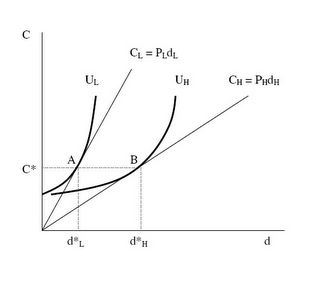
Thinking about it a little further, this situation is not only harmful to the department/university itself, but also to the students, and to the employers. A prospective student of the regular program would think twice: why should I work harder than some other students, if we would all get exactly the same labels? Below is a brief explanation of the effect to the hiring company (see graph above):
Think about a company seeking for two employees with master’s degree in economics. Assume that two of our graduates fill in the application. The company doesn’t want graduates from other university. Our two graduates hold the same diploma. But their quality differs. Graduate L has low probability (P) of failing his assignment, while H has high probability. Both alumnae’s utility curves are shown accordingly. Note that C is “coverage”, or think about wage; and d is “premium” or, for that matter, effort required from the employee. Don’t over-interpret “effort”. It simply means, “If you are not good enough, then you should work harder to be in par with the other – if you demand equal wage”.
The company system goes like this: the more likely you are to fail your task, the more effort you should undertake, and we will pay you accordingly. Obviously from employee’s point of view, less d and more C is preferable – hence the shape and the direction of the utility curves.
If the company can clearly separate between the “low-risk” and “high-risk” employees, it can require different effort levels. For a given wage level, therefore, the equilibrium is A for the good graduate and B for the worse graduate. However, many times, companies fail to identify which one is which – especially when their diplomas are identical. So, since both types prefer A to B, the former will be chosen by both. In this case, the company will make zero "profit" with L-type and negative profit with H-type. If the company wish to prevent any H-type (whichever graduate it turns out) to move to point A, and therefore implements a single rate (d*LH), it will make profit at the cost of low-risk employees.
On the other hand, the good graduate is surely disadvantaged by the situation. With the same effort level with the worse graduate, but with higher quality, he is underpaid (or put differently, the worse graduate is overpaid).
In plain words: moral hazard is at play. And maybe adverse selection as well.
Tuesday, July 19, 2005
Microeconomics Exam
- Think about a monopoly market.
- A monopolist is a single player in its market. He/she can search for an optimal price. However, a rational monopolist can not set any arbitrary price. Why?
- Imagine an apple monopolist in
- Following on # 2:
- The
- As it turns out, the new entrants put downward pressure to price. Now you can buy apple in
- Threatened by the increasing competition, Patrice changes her strategy. She buys a new technology from
- As they are the only players now, Patrice and Patrick become extra cautious. Meaning, one’s decision takes into account the other’s as given. What type of equilibrium do you expect?
- Explain the interaction process between Patrice and Patrick if: i) Each assumes other’s output as given then act accordingly; ii) Each assumes other’s price as given then act accordingly; iii) Patrick observes Patrice’s output, then decides his own.
- Exhausted from harsh competition, Patrice and Patrick agree to negotiate. They agree that profits will be joined, then shared proportional of outputs produced. Each may choose to produce 50, 75, or 100 apples. You are told that the total joint profits are Rp 3,200, Rp 3,500; Rp 3,000; Rp 2,100; and Rp 1,000 for total quantities of 100, 125, 150, 175, and 200 apples per day, respectively.
- Find the Nash equilibrium.
- Find the Stackelberg equilibrium, assuming Patrice as the first mover.
Friday, July 15, 2005
Save the energy and all the nonsense, 2
But if you want the shortcut by turning off the LAN at 4pm, I'm afraid that's not a good idea. I had a discussion with a consultant hired to help manage one of the state-owned enterprises. She complains that now she rarely can work as productive as before because "there is no internet to access important documents online". I believe this is not peculiar to her. In some busy offices, you need to stay until nine at night, because you have to exhange urgent emails or calls with somebody in New York who happens to be in his/her morning primetime. Some stockmarket analysts really work after midnight and they do make use of cables broadcasting real-time financial news. Now you want to stop all that?
Think about the president's instruction to stop wearing suit ("let's now wear our own traditional customs" -- my goodness; the government now wants to tell you what to or what not to wear??) , start using stairs rather than elevators, reduce the use of air-conditioners. It sounds good. But what is the reason for having ACs and elevators at work in the first place? Convenience, comfort. And why are convenience and comfort important? For better productivity. Imagine office workers with less elevators and ACs. Do you expect increase in productivity?
I'm all for rational energy saving. But not for all the nonsense as I have written below.
Addendum 1: A friend wrote me: "OK, you're saying that the Presidential instruction did not even touch the root of the problem. What is the root of the problem?". My response: "Comprehensive energy policy". He goes, "Well, that's cliche. Give me one reason why you think reducing the use of elevators, business suits, etc is not gonna work". I replied, "Illustration might work for you. Look at the chronic traffic problem in Jakarta. If you happened to be trapped in the traffic jam Friday last week, you should have come to realize that your car was simply, well, an umbrella. A very expensive umbrella, why? Because it protected you from the heavy rain; yet the fuel was burning all the time while the car stayed still in the jam for hours. How many litres of fuel do you think Jakarta people waste in their daily traffic problems? A lot. Indonesian people? Even more. Do I think it's higher than the energy we can save from reducing elevators, suits, etc? Yes I do. So I would like to see a comprehensive energy policy that also, among all, addresses the traffic problem". My friend was not satisfied, "But don't you think there are people wasting energy in the offices?". I responded, "Of course I do. Go to government offices at nine o'clock. How many officials are playing solitaire? How many are reading gossips in the internet? How many are chatting in friendsters? A lot. The problem is, can the government itself identify all this? And even if it can, can it tell the inefficient officials from the efficient ones? Probably not. Moral hazard is at play, and pooling equilibrium is sometimes an easy shortcut...". My friend: "Stop it, you're getting too academic. Give me a break: What is your 'comprehensive energy policy' in one word?". Me: "You're typical. You don't even want to listen. But I'm getting used of people like you. My answer is: PRICE". My friend left.
Addendum 2: A collegue called me. Him: "Why do you sound so harsh to Mbak Ani? Isn't she your tutor at LPEM?". Me: "Don't get me wrong. She's not only my tutor, she is my teacher. In fact, she is one of my favourite economists. And that's why I don't want her to go the wrong way. I still want to believe that it's the newspaper who misquoted her. I don't believe that she really meant that saving energy has really nothing to do with producticity. That's why I critiscized the statement in the newspaper. That's what friends are for, isn't it? After all, I praise what she does right. Knowing her, I think what she was really saying is actually: 'Saving energy is good. Productivity is good, as well. Now there are inefficiency here and there. Let's tackle them so as to save energy and to increase productivity' So the problem really is, how to exactly identify the sources of inefficiency and shoot your silver bullet. But as I say, this 'INPRES' is at best a pain reliever. It's not solving the problem. No, as long as you we live with distorted prices".
Addendum 3: A relative called up: "Why do you and your friends keep suggesting correcting the (BBM-) prices?". "Why don't you just recommend a total cleanup in the corrupt Pertamina?". My take: "We should do both: correct the market failure and ccombat corruption". The relative continued, "The price hike. Why now?". My answer, "So, when?".
Addendum 4: A fellow blogger commented (see "comments" below) that she agrees with "leave-your-suits-at-home" policy, because of a reasonable reason. However, my point was more on citizen's freedom of wearing what he or she likes. The Government really should stay away from this one (and many others, for that matter). (It occurs to me, by the way, my friend's example of "kemben" can not be generalized. My traditional clothes are far complicated than business suits. But, no I don't really love business suits either; stop by my office, if you don't buy this-- it's just that I hate government intervention in every private matters).
Monday, July 11, 2005
Save the energy and all the nonsense
I say, oh my God. It's indeed hurting to see people are fighting for an access to fuel with "affordable" price. But the price has been manipulated. What stays in people's mind is wrong price. And it needs to be corrected so as to stop lying to people. But instead of trying to fix the price, everybody prefers to prolong the lie and to keep singing the fatal lullaby, that the price is alright. That this is temporary; tomorrow everything should be okay. Better to use some persuasion. Since when moral suasion works in this country? Unfortunately not only the government; some analysts, celebrities, and other public figures start echoing all the nonsense. Either they don't know what they're doing, or they deliberately do it to win the public's heart. Being politically popular is key to maintain political power. And it's not necessarily economically logical. Some "economists" even deny the very basic economics. That when you hold prices below what it is supposed to be, you would see either of two results: 1) the market cries out for subsidy, 2) a long line of queue. In worst situation, you will see both results. As in now. Even for these economists, being popular seems more important than to acknowledge the real examples of what they learned in schools.
What's so hard to understand that people do respond to incentives? If you really face a shortage problem, trust me, the only effective measure to fight it is ... well, price-- since shortage means the price is distorted (not necessarily means "scarcity"). Think again of your "heartful" solutions: stop using elevators, air-cons, suits, etc. Did you ever think why these pratices existed in the first place? Because people need a comforting environment to work more productively. Now go tell your staff to cease using elevators. Shut off all the air-con system. That's fine. You are saving the energy. But don't tell me you still expect a boost in production, or even to maintain the existing one. And what's with the midnight broadcasts? Some people have their peak productivity at night time. They work extremely well at night. With the accompany of ... well radios or tv programs (news wire, Bloomberg index, you name it). But sorry dudes, your government is imposing a new work habit for you!
The real sad thing is, this way of thinking is not peculiar to energy problem... It is pervasive.
Wednesday, July 06, 2005
Lines for BBM
Solution? None. Nothing, unless you are willing to listen -- even if it's not popular.
Friday, June 24, 2005
Coordination razzle-dazles: infrastructure
But, continuing on my frustation yesterday, it simply appears to me that the government really has coordination problem. Mind you, Bappenas is government. Jasa Marga is state-owned. Sounds familiar?
Wednesday, June 22, 2005
Coordination razzle-dazle: oil
What really bothers me from all the news is the mess in coordination. The state-owned oil company, Pertamina blames it on the government, and the government via the Ministry of Finance fires back to Pertamina. In the meantime, the state-owned energy company, PLN blames the government for not backing them up when they are short to pay the supply from Pertamina. Pertamina refuses to supply since it is not "appropriately subsidized" by the government. The Minister of State-Owned Enterprises seem confused. And there comes Pertamina-Exxon dispute. Cepu is supposed to produce one tenth of the national oil output. That's a lot, especially in these tough days. But the government seems lame in solving the dispute.
What in the world is going on? Do we not have that function we usually call "coordinating" minister? If the government really can't manage itself, isn't it a justification for more privatization? (Oh by the way, I was told, the coord-min wants privatization; it's only that, some ministers are strongly against it).
And, to add to my frustation: Speaking about oil, this is a piece (in Bahasa) by an adventurous politician sometimes calling himself an economist (I was a big fan of his writings -- not anymore after his pieces like this and this) and now trying to wash his dirty hands, using angelical words. I'm disgusted.
Friday, June 17, 2005
Fine survey, poor inference
I'm not against decentralization. In fact, I like the idea of decentralization. But I have problem with the inference drawn by the research team -- or rather, on the way the team drew their conclusion. Look at their questionnaire here. One question to -- supposedly -- capture households' perception on decentralization, i.e. "local autonomy" is
"Local economy is currently undergoing since 2001. In your opinion, how is the quality service [sic] of [...] in the district/municipality compare to year 2000?" The items for [...] are school, puskemas (health clinic, head of village, sub-district office, and district/municipality office. The options for responses are 1) Worse, 2) Same, 3) Better, and 4) Don't know.
Now, from that kind of question, do you dare to make an inference about the effect of autonomy on public services? I would not.
Try another one:
"In you opinion, how is the quality of [...] program implementation in this district/municipality in 2001 compare with [sic!] year 2000?" The items include for example "poor people empowering" and the response options are 1) Decreasing, 2) Constant, 3) Increasing, and 4) Don't know.
Again, can this kind of question lead you to conclude that the autonomy or decentralization lead to improvement or disimprovement?
Probably yes, if you can find some way to isolate any possible other factors that might determine the change in "poor people empowering" etc. Just because many respondents said that "poor people empoering" is "increasing" is no justification to conclude that it was due to autonomy policy or decentralization, even though you picked up the relevant periods of time.
This is the same with the former question above. Just because majority of respondents said that the school quality is better in 2001 compared to 2000, you can't just conclude that it was because the autonomy/decentralization.
All that was presented yesterday was data frequency and percentages. No parametric treatment whatsoever. So, I was very surprised with such a strong conclusion.
It strikes me that people can rush to make inference that way. That is a dangerous approach to data.
Thursday, June 16, 2005
Credit, motorcyle, and interest rate
Secondly, still related to that easy credit. It seems to my friends that interest rate really does not matter to the motorcycles buyers. They just require a credit scheme -- no matter how high or low the interest rate is. This is worth investigating. Since, "it is possible that the credit scheme is not a function of interest rate anymore -- it is the other way around!". This is really intriguing as well as challenging. If I have time and data, I'd love to test this hypothesis. (Students: want a good topic for thesis?)
Thursday, June 09, 2005
Old Soldier Strikes Again
(Somehow I remember my wild idea last year to legalize the now-illegal logging using a strongly enforced tax mechanism)
Monday, June 06, 2005
Freakonomist Has New Column
"Chen is a hyperverbal, sharp-dressing 29-year-old with spiky hair. The son of Chinese immigrants, he had an itinerant upbringing in the rural Midwest. As a Stanford undergraduate, he was a de facto Marxist before being seduced, quite accidentally, by economics. He may be the only economist conducting monkey experiments..."
Friday, June 03, 2005
May's Inflation is Even Lower
"May 2003, was marked with 0.21 per cent of inflation. Based on the Consumer Price Index (CPI) calculation in 43 cities, inflation was experienced in 30 cities, while deflation happened in 13 cities. The highest inflation was in Palu (2.31 per cent), whilst the lowest inflation was in Palangkaraya (0.01 per cent). Meanwhile, the biggest deflation was experienced in Padang Sidempuan (-1.09 per cent) and the smallest inflation happened in Bandung and Purwokerto (-0.04 per cent). The inflation was contributed by the increase in the prices of some goods and services groups as follows: prepared food, beverages, and tobacco products (0.01 per cent), housing (0.76 per cent), clothing (0.35 per cent), health (0.81 per cent), education, recreation and sports remained stable (0.00 per cent) and transportation & communication (0.03 per cent). Meanwile, unprepared food experienced a decrease as high as minus 0.28 per cent".So, what do you say about the "terrifying impact of BBM price hike on inflation rate" now?
Meanwhile, some economists claim that BPS growth report is misleading. Since "it does not take unemployment into account" and "the fact is, consumption has been decreasing; why would then we have high growth?". Since when, we put un-employment into growth accounting? Since when, GDP is just consumption?
Wednesday, June 01, 2005
NR&Env Econ Exam
The Natural Resource and Environment Economics, final exam last week. This is somewhat a watered-down version of the mid-term --which turned out not to be very rewarding.
- What do we mean by efficient allocation of scarce water? Do you think we in
- What do you think of the “Global Scarcity Hypothesis”? Does it make sense? Why or why not?
- Should we privatize our forests? Why or why not? (For either case, please provide an economic argument, not a romantic one *).
- Explain again, why maximum sustainable yield can be a bad target for fish catching if the objective is to conserve the fish?
- Give me one reason why the government should intervene in supplying water. Elaborate on that. If you don’t think there is any single reason, argue.
Wednesday, May 25, 2005
Second best: corrupt fundamental
But will these all work? Looking at the chronic situation in Indonesia, I sadly see no prospects. Corruption is already a culture. It's ubiquitous.
While, to add to that pain, we've got little money and resources left. Yet, we've got to grow.
Now, I could start understand the points made by Avinash Dixit in his "Lawlessness and Economics". In short, you can't wait until the coast is really clear. You have to be able to develop and to grow on a ... corrupt fundamentals.
Tuesday, May 17, 2005
I'm back -- I'm trying!
Here are some things that I would have blogged within last month:
1. My pick for Alan Greenspan's successor: Ben Bernanke.
2. Daron Acemoglu deserves John Bates Clark Medal.
3. The economics rationale of getting married. Oh by the way, this is another reason why I have been absent for awhile.
Monday, April 18, 2005
Quality OK, Delivery No
Friday, April 08, 2005
Is potato Giffen?
Varian doubts it ("Samuelson reads too much Marx").
Statsny says it depends.
Rosen writes in JPE.
I'd say just call the whole thing off.
Thursday, April 07, 2005
Freakonomics
Friday, April 01, 2005
Klein answers Thaler-Sunstein
My take: It is tempting to then replace the l-p with "benevolence" and that would fit the examples in T-S paper. But, I would have asked Klein, what should we call government planning endorsed by the house of representatives?
Looking forward to T-S's reply. Or better yet, some words from the rhetoric expert, Dee McCloskey.
Friday, March 25, 2005
If people just want to think
This is getting pestiferous!
Thursday, March 24, 2005
Midterm Exam: Environmental and Natural Resources Economics
- We have discussed about the two opposing views of the future: optimistic- and pessimistic models. Summarize their claims briefly. Since they talk about the future, we cannot satisfactorily decide which one is right now. (The “famous bet” between Ehrlich and Simon might just be a pure coincidence – well, it was a bet!). So, what criteria do you think we might propose for evaluating the predictions of the two views?
- Economists have been valuing the environment. Do you think it is ethical? Why or why not? Why do we need valuation? What are the limitations of environmental valuation methods offered by economists?
- Sustainable development is a matter of sharing costs and benefits between generations. True or false? Why? We don’t know what our grandkids really want, but we sometimes assume that they would like the forests to be preserved, instead of a huge shopping mall to replace the forest. Why do we do this kind of “paternalism”?
- One of the practical implementations of Coasian approach in environmental policy is marketable pollution permits. Do you believe market can take care of the environmental problems? Why? In case you do, tell me how. Another thing, is it ethical to look at the pollution as a factor of production? Give me your argument.
- In discussing the issue of population bomb, we talk about the economics of population control. Now tell me what you know about the economics of childbearing. Gary Becker says, children are durable goods. Maintaining them incurs costs and benefits. So, optimize! Comments?
- Read the small box in Tietenberg page 293. Yes, it’s about the “Harbor Gangs of Maine”. It seems to me that informal arrangement can be sufficient to ensure efficient harvesting. Am I right or wrong? Why?
- We have talked about environmental injustice. It is the condition where those who bear the negative externalities of environmental deterioration are also those who are poor. But hey, this is like what’s happening everywhere. Can you think of a rich community that is willing to bear the negative externalities? If you can imagine one, why do you think the relatively rich people want to do that?
Monday, March 07, 2005
Ticket for gas
Addendum:
My sister responded again:
I got the point of difficulty in monitoring. In fact what I was particularly wondering is how to make people that use public transport, regardless of being poor or rich, pay bbm/liter less than those use private cars. The justification made is simply that people using public transport use up much less space of the road and do not get as much convenience as people using private vehicle. I am fully aware of the absurdity of effort to identify who the poor or rich are in Indonesia.I mentioned about ticketing for buses through which government gives subsidy to the public transport users, i.e: users buy bus tickets at Rp. X, then the bus operator can reimburse the tickets at Rp X+Y. ticketing system has been applied for KRL (have no info of how it works). Unfortunately, as you said, for ticketing, there is always an issue of ticket faking. Now, what about allocating oil stations for buses where oprators can get cheaper bbm?
And I told her, please keep stimulating such good ideas; and don't get tired by economists' skeptical starting points in looking at things -- they are skeptical.Nice thoughts. On your last question. We sure hope the bus drivers do not have some evil pact with some guy somewhere: fill up their tanks repeatedly, and go sell somewhere else at higher prices. Arbitrage at play.
BBM and sustainable development
Finally someone looks at the BBM fiasco from sustainable development perspective. Very well done, Bang. Thanks for educating that to public.That's an SMS I sent to this great person (I have no idea if this site is official or not) in response to his article today in Kompas.
Sunday, March 06, 2005
Libertarianism vs Conservatism
Somehow, I am relieved that I don't need to resort on either one. I have my own principle and so far so good.
Friday, March 04, 2005
Malaysia, you're getting into my nerve!
IMF is loosing its focus, too
Monday, February 21, 2005
Microeconomics 2
Texts: Hal Varian (HV) and Andreu Mas-Colell et al. (MC)
Coverage: Markets (Perfect, Monopoly, and Oligopoly), Uncertaity, and Game Theory.
Outline: 1) Overview/review (HV 1,26,27; MC 1, Math App), 2) Perfect Competition (HV 13, MC 10), 3) Monopoly (HV 14, MC 12), 4) Oligopoly (HV 16, MC 12), 5) Uncertainty (HV 11, MC 6), and 6) Game Theory (HV 15, MC 7,8,9).
I know this is unusual. As some have said: when it comes to HV and MC, it's an "either-or" thing -- you can't use both at the same time. Let's see how it plays out.
Having done the changes, I guess I would also adjust my Microeconomics 3 course next semester as to stress more on General Equilibrium and Welfare Economics and less on Game Theory and Uncertainty.
Wednesday, February 16, 2005
Limits to Rationality
“most economists recognize that some of the people are not fully rational some of the time, and some of the time that matters.”On traditionalists view that rationals cancel out irrationals,
“The combination of free entry, unfettered competition, and free choice seems hard to quarrel with, [h]owever, if participants are not well-informed or highly motivated, then maximizing choice may not lead to the best possible outcome.”
Behavioralists disagree, arguing that bounded rationality does indeed bump the market’s invisible hand.Of course, Gary Becker slightly resists:
“While I believe there’s value in some areas of psychology, the focus is different...” “We’re interested in how groups respond.”To which Thaler comments:
"Division of labor strongly attenuates if not eliminates any effects caused by bounded rationality".
“Maybe Gary Becker sometimes confuses behavioral economics with psychology,” says Thaler. “Because behavioral economists think about markets all the time.”And yes, don't forget Thaler-Sunstein good paper, Libertarian Paternalism.
Monday, February 14, 2005
Sorry
I was busy completing research reports.
And in the meantime, was also busy trying to understand this man and this man (in Bahasa). And the men are no blogging!
Thursday, February 03, 2005
NR&Env Econ Course
This course is a blend of two parts, namely Environmental Economics and Natural Resource Economics, with more emphasis toward the former. The purpose of the course is to provide an overview of the principles of economics used to analyze environmental and natural resource problems. As of completing the course, students are expected to be able to assess environmental and natural resource problems with economics point of view and offer policy recommendation accordingly.
This is the outline:
1. Introduction (Tietenberg, Ch. 1,2,5,21,22,23,24 / Julian Simon vs. Paul Ehrlich – some clippings.) 2. Property Rights, Externalities, and Market Failure (Tietenberg, Ch. 4 / Coase, Ronald, 1960.Social Cost," JLE 3:1-44)
Tuesday, February 01, 2005
"Very Good News"...
Dear Arianto:to which I replied:
Your dissertation was chosen as the most outstanding in our Department for 2004 and is being submitted to the AAEA national competition... Congratulations! I am honored to be associated with your work ...
John
Dear John:I am very grateful to receive this recognition. No doubt, I owe this to you. I don't think I could even graduate in time without your guidance. Thank you so much!Arianto