Wednesday, January 12, 2005

The next Julian Simon

I confess I haven't read Huber and Mills' Bottomless Well. But thanks to Tyler Cowen at the Marginal Revolution, I now know what it is about (yes, I trust Tyler's reading). In Tyler's words:

1. The cost of energy as we use it has less and less to do with the cost of fuel. Increasingly, it depends instead on the cost of the hardware we use to refine and process the fuel. Thus, we are not witnessing the twilight of fuel.

2. "Waste" is virtuous. We use up most of our energy refining energy itself, and dumping waste energy in the process. The more such wasteful refining we do, the better things get all around. All this waste lets us do more life-arrirming thing better, more clearly, and more safely.

4. The competitive advantage in manufacturing is now swinging decisively back toward the United States...[information technologies]

6. The raw fuels are not running out. The faster we extract and burn them, the faster we find still more. Whatever it is that we so restlessly seek -- and it isn't in fact "energy" -- we will never run out. Energy supplies are infinite...


Of course the above is hated by many environmentalists. Somehow this reminds me of the famous bet between Paul Erlich and Julian Simon.

Tuesday, January 11, 2005

Monsanto-gate

Monsanto has been bribing Indonesian top officials and their family. The Jakarta Post reported:

"... People from Monsanto met with a senior environment ministry official on several occasions.
... an employee of the consulting firm which represented Monsanto visited the senior official at his home and gave him an envelope containing $50,000 in $100 bills.
... Monsanto made at least $700,000 in illicit payments to at least 140 current and former Indonesian government officials and their family members.
... The largest single set of payments was for the purchase of land and the design and construction of a house in the name of a wife of a senior Ministry of Agriculture official, which cost Monsanto $373,990.
... Other improper payments included, among others, payments to a senior official of Budget Allocations at the National Planning and Development Agency (Bappenas), totaling $86,690, and payments to other Ministry of Agriculture officials, totaling $8,100.
... Officials of the South Sulawesi office of the agriculture ministry also received approximately $29,500 from Monsanto.

I guess this would either a) send some vip's to jail or b) just vanish in the air.

RIP: Robert Heilbroner

The author of the ever-illuminating Worldly Philosophers, Robert Heilbroner died today in New York. Another great loss.

Monday, January 10, 2005

Early warning system

I agree with Posner, we should build one:
"...[P]oor countries may not have the resources to create tsunami warning systems or take other precautionary measures that wealthy countries could afford to do. I would rephrase the point as follows: the budget for disaster prevention will depend on the competing claims on public and private funds. The more urgent those competing claims, the rationally smaller will be the budget devoted to disaster prevention..."
"...But to keep matters in perspective, although per capita incomes in the nations affected by the recent Indian Ocean tsunami are roughly 10 times less than the per capita income of the United States, the four countries principally affected--Indonesia, Thailand, India, and Sri Lanka, have an aggregate GDP of hundreds of billions of dollars. A tsunami warning system might cost only a few million dollars a year..."

Friday, January 07, 2005

RIP: Gerard Debreu

Professor Debreu died today. Condolences.

Thursday, January 06, 2005

Moratorium or relief or what?

My two-cent op for those debating on debt moratorium:

1). Debt moratorium is not the same as debt relief. The former is temporary suspension, and the latter is permanent reduction/deletion or simply rescheduling.

2). G2G-based moratorium for official debts is very possible. But only for those under bilateral agreement. Those signed under the Paris Club are subject to discussion -- and a tough one, most likely. In the meantime, debt relief is still possible but less likely (unless Indonesia poses similar importance to donors the way Mexico was to the U.S. back in the Clinton years).

3). It's almost impossible to get relief (not to mention moratorium) for commercial debts. After all, corporations are no charity. (They will donate some money of course, for image-building).

4). So what now? Here's what I would suggest : 1) Demand debt relief (as so promised by U.K., Italy, and Belgium) -- I could imagine this would be relatively more manageable for bilateral agreements. But it would be extremely tough for multilateral: Paris Club is a cartel and the brain-child of the IMF; remember GOI has said no to the Fund; hence no more Paris Club dinners, 2) Demand debt moratorium (from Germany, U.S., Japan, Canada, and France).

5) If you are concerned with our rating, points in # 4 above will not hurt (read S&P Bulletin today) insofar the debts we are talking about are official debts. When it comes to commercial debts though, things are not pretty (see # 3, and in addition, unlike the case of official debts, this one is subject to lowered rating).

6) Yet, some would understandably cry out: why oh why are we still talking about the damn ratings in the midst of this sad sad sad catastrophe? Well, because those herds called Corporations out there always wake up in the morning and look at the S&P ratings before deciding where to put money today. And the thing is, it's commercial debts that are more volatile. Unfortunately, we are not sure if can play the Mexican way...

Tsunami's impact


Tsunami's impact (source: Citigroup: Hanna et al, 2005) Posted by Hello

The above graph (click to enlarge) shows that the impact of the recent Tsunami on financial markets is not gigantic. (Thanks to Anton Gunawan for the article).

On the economics of the Tsunami see the interesting discussion of Posner and Becker today. They both agree that despite the great uncertainty of such catastrophe, a good early warning system should be provided. Becker goes on to offer solutions. In the long run: invest on education; and in the shorter run: good access to market insurance. But, as Becker admits, these both are not easy to do, especially by low income countries. And of course, moral hazard problem. See a rejoinder by Lynne Kiesling.

My take: Yes, the economic costs of the Aceh's Tsunami might not be gigantic. However, this event requires extremely careful response from the government. Yes, we expect (and have been promised) huge amount of foreign aid. Both in the form of grant or of debt forgiveness. Good diplomacy is crucial, because no such thing as a free lunch (recall: Rubin-Summers-Greenspan's unpopular determination to help Mexico in the Clinton years)

Tuesday, January 04, 2005

Education: basic first!


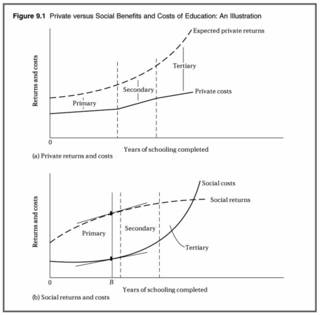
Returns to and costs of education (graph by Todaro) Posted by Hello

Over examining a doctoral dissertation, a collegue and I were involved in a discussion. The examinee modeled public education provision and how it affects (or affected by) interregional movement of students. One of the results seems to imply that higher education should be centralized. Despite the fact that the dissertation treats education as consumption-only, not an investment (one serious weakness, I think), the collegue rightly argued that it is the basic education that needs centralization more than higher education. He backed up his argument with G. Psacharopoulos' finding that the returns to investment on basic education is greater than that on higher education. The referred study is a classic, and the finding seems to be a stylized fact these days (Psacharopoulos has updated again the paper in Education Economics, 12(2) Aug 2004 -- subscription required). I would have stated my agreement with him.

But instead, I misunderstood my collegue's point, and rather, raised another related point, namely: the the social returns to investment on higher education is lower than its private returns. Of course I had in mind the graph above (from the Mike Todaro's Economic Development that in turns also cites Psacharopoulos). In particular, what I really meant was that in the case of higher education, the net private returns exceeds the net social returns. This is shown in the graph above where the expected private returns and private costs diverge; while the social returns and social costs converge (and later, cross and reverse).

So, basically my collegue and I were in agreement as far as the public policy on education was concerned. That is, if the government is to centralize public education, it should do it to basic education first (In fact, I even tend to think, for higher education, no centralization should be encouraged).

Friday, December 31, 2004

New year's tears


Tsunami (photo courtesy of ThinkQuest) Posted by Hello

Suboptimal riposte

Please, all you who appreciably want to donate to or to help the victims of the Tsunami, think twice. No, I'm not saying you should not participate. Your helps and donations are of course 'priceless' (or so you think). However, many, so many of the donations so far are suboptimal. People keep sending unprocessed food (raw materials) and nobody can cook over there! Even drinkable water is terribly scarce. The lists of volunteers keep expanding every minutes. But many of those who want to be sent are not the ones the victims need. They need paramedics. Not just anybody who in turns need to eat there too. If you have all the sympathy for Aceh's tsunami victims, and you have the urge to go there, make sure you can help, not to be helped. And those who want to donate, please donate money, so the centers whatever they are can use it to buy relevant goods: body-bags, disinfectants, medicine, biscuits, bottled water, etc. I agree with a friend: this requires a careful organization. And a quick, systematic one. Yes, military.

Wednesday, December 29, 2004

RIP: Susan Sontag

In the aftermath of the Tsunami, in the midst of my condolences to the people of Aceh and the surroundings, another one eulogy goes to Susan Sontag in New York. Unlike you, Dave, I am not happy about that.

Tuesday, December 28, 2004

Put back economics into Environmental Economics!

I was a little surprised today and last week to observe my students presentation on their environmental economics projects. ("Surprised" being a euphemism). Not a single group used economics to explain environmental policy recommendation. (Well there was one, and it was sadly irrelevant). Of course this is not entirely their fault. I felt guilty: I might have failed to teach them. Or, to make me feel better, I was silently blaming those who had supposedly taught them the basic microeconomics. Should really find out another way to deliver this course next time. One group dared to suggest zero pollution, while still implying the need of, well, growth! Others were not even suggesting anything: it's all about issues, newspaperic issues. I felt terribly, terribly guilty...

So in this other class, that was scheduled to be discussing sustainable development, I started with a pamphlet: "I'm an 'environmental economist', and I am going to talk today about 'environmental economics'. But first, forget about that first word in those two phrases. We here are learning economics. Later we are going to apply it to help solve the environmental problems". I went on talking about how I am more persuaded by Bjorn Lomborg instead of by the infamous doomsters, Club of Rome. How I agree more with Becker than with Posner regarding the Kyoto Protocol (by the way, the Becker-Posner Blog is getting better: in addition to their global warming debate, the recent one on disease and growth is noteworthy -- Becker being anti-Malthusian and Posner pro).

The challenge we in the field face these days is arguably not how to contribute alternative solutions to the environmental problems. But first of all, is to convince the general public that economics offers a way around them. And the difficulty lies in the fact that most of the economic approaches are simply... unpopular.

Tsunami next door

May they rest in peace.

Saturday, December 25, 2004

Starbucks assumes my taste

I don't hate Starbucks like these people. In fact, I go to Starbucks quite often. But today I happened to notice: Starbucks assumes my (and maybe your) taste. I was ordering a small, black coffee, as usual. This waitress, she handed me instead a mug with ... hot water and black ... well, tea. Me complained. She goes: "Oh, sorry, Sir. So sorry. Let me make it up for you. I'll make you a ... cappuccino, alright?". WHAT? Why did she think I valued cappucino more than black, plain coffee? Of course I said no, I want BLACK coffee! (today they had Sumatran).

Bear with me -- more interesting one coming. There I was, sitting on a comfy couch reading my book. One subchapter done, and time for the next gulp of coffee. But, hey, what's that little thing moving around on my coffee? A suicidal fly! So, yes, I stood up for the second complaint of the day. This time, another waitress apologized. She goes: "Oh my good God! Please forgive us, Sir. I'll change your coffee..." (At the moment, I thought, she didn't need to apologize. The dead fly should). Anyway, she gave me another mug of coffee. Thanks God, it's black. Only that... "Here you are, Sir. As a guesture of our state of sorry, we give you a ... bigger mug... no extra charge"... Oh, my God! Did she think I ordered small coffee, because I couldn't afford the bigger one? Even worse, did she think I valued bigger mug of coffee higher than smaller one? (Now I think she should apologize!)

Both fiascos once again prove: most people confuse value with price. True, price should reflect value. But my valuation might be different from yours and therefore I might not think the price is right (for me), while you think so (for you). Disaster comes when you think the price is right for your valuation, and ... mine.

Tuesday, December 21, 2004

Chatuchak


Posted by Hello (photo courtesy of AsiaTravelTips)

...as you might wonder what it looked like...

Sunday, December 19, 2004

Krung Thep

Hi, I'm blogging from an inn in Bangkok. Attended the annual forum of EADN -- a child organization of the GDN. We were discussing the current development issues and challenges in the East Asian region. The forum ended on Friday, but I extend my stay until tomorrow morning. A friend has been very generous to let me stay in his place yesterday. But today he has to go to Myanmar, so here I am updating you from this bed-and-breakfast place: yes, it is in that kind, but ironically, this is where I can get good internet connection (even in the hotel the forum was held, the connection sucks!). And, it's inexpensive. I pay only 550 bahts (that's 12 bucks) for one night plus another 100 bahts for a whole-day access to wifi-hotspot. Cool! (By the way, this place is recommended by Lonely Planet).

OK, what was it I wanted to write you again? Right, the EADN forum. But... I guess I change my mind. I'm more excited to talk about Bangkok, the Oriental City. I was expecting a city similar to Jakarta: busy, crowded, traffic jam every where. Well, it turned out very close to it, except that, Bangkok now has a very nice subway system that started to operate just recently. It is integrated with the older skyway train. This of course is a very big improvement to the city's problem of congested traffic everyday. However, to my surprise, not many people use that subway! A Thai friend of mine explained that people have not adjusted well with the new facility. In addition, for now it only serves limited routes. People still prefer the traditional road traffic. And that explains why the road is still chaotic. A stranger like me is probably one of the few people who can enjoy the nice subway. It's very clean and ... well, new. You don't even find posters or ads down there. Never mind stores or ... hobos. But maybe my friend is right: it takes time. I was wondering: in the next annual forum, I will probably see a very different subway... (if the subway were in Jakarta, you know exactly what I mean)

Another difference I notice between Bangkok and Jakarta is prices. To say it directly, it's cheaper here. I went to the famous weekend market, Chatuchak yesterday. It was awesome. You can find almost everything very cheap. Not only that, they imitate branded products massively. I saw an American female tourist bargaining over a fake Rolex watch. She got it for ... less than 50 dollars! (It might break after two weeks, but who cares?)

See it yourself. And don't you forget to try this.

Tuesday, December 14, 2004

So long, departure tax

(Sorry, can't find the link, this is a news from a high level official -- will update you later). The departure tax is going to be abolished (it takes 4 years to finalize, eh?). Good. But wait, rumor has it, application fee for passport will increase ... 5 times as much! So, those who travel frequently will be happy. Those who happen to travel only once in their lifetime will be sad. The former consist of, mainly, business people, academics, bureaucrats, etc. The latter, maids, low-wage workers, etc. See my point?

Saturday, December 11, 2004

Becker-Posner Defense: Still Silly

So replies Becker, there are 3 options: 1) pre-emptive attack, 2) wait and retaliate, 3) accumulate information before decide. The most economic way today, says Becker, is the first one. Because, "deterrence is less powerful now as a tool against certain enemies than during the cold war when the adversary was a single major state..."

And Posner adds, "The case for preventive war must be debated on its merits rather than rejected outright on the ground that any war that is not defensive is aggressive and therefore "illegitimate.""

Again, Prof. Becker and Judge Posner: I can still use your arguments in favor of Iraqis and against Americans. Think about it. How would you define "irresponsible nations with powerful weapons"? What precludes it to be... the U.S., Professor? As for your assertion to merits: there you go. It has been going on forever, Judge.

Wednesday, December 08, 2004

Stiglitz vs Stiglitz

The Indonesian Economists Association (ISEI -- No, they don't have a website!) and Economica, a student-run organization at the Department of Economics University of Indonesia (I recall they HAD a website -- but it's lost in the cyberspace, no?) are hosting a public lecture featuring the Nobel laureate Joseph Stiglitz. Mind you, "public" here means you have to pay Rp 5 millions for the ticket. That's $500. Man, I'd rather use that money for more useful activities like this, this, or this.

Yet, I might be part of the conspiracy now. The committee has asked me to become a jury for an essay competition. The idea is, the first and second winner will get free ticket to the Stiglitz lecture. They have to write a good essay exploring Stiglitz's economics views on development. I repeat: on development. That means, he's going to talk again about the increasingly boring stuff of globalization (for better or worse). So yes, it's about Stiglitz the anti-IMF, not about Stiglitz the respectable risk-and-information economist. It seems to me, people take Stiglitz too much for a somewhat incorrect cause. Just because he won the Nobel prize for economics, people think he is good in everything. Well, I think he is good but he is certainly not the best, when it comes to politics. Or put it this way: when I need to learn about politics (or, even, development), I would not read Stiglitz for reference. As for a econ-popularizer, I'd rather read Krugman.

Poor Stiglitz. As I always say in my microeconomics class: read Stiglitz papers in JET (on risk and uncertainty), QJE (on imperfect information), and AER (on monopoly and the rate of extraction of exhaustible resources) -- each requires subscription. THEN, go ahead read the entertaining "Globalization and Its Discontents" or "Roaring Nineties". Then you can see his split personality: smart economist and somewhat-lousy political analyst.

So yes, Stiglitz is kind of overrated. But he seems to enjoy it. Well, At least I hope he will clarify what his Nobel was for.

A note on the essay competition. These 5 finalist essays: most of them mistake Stiglitz. Some even seem to think Stiglitz won the Nobel for his war against the World Bank, IMF, and the WTO. (Oh, by the way, I found one plagiarist. Rather than grant him a $500-worth ticket, I would suggest to fine him $1000 for the cheat).

Monday, December 06, 2004

Becker's debut: not cool

I'm always admirer of Gary Becker. But his justification on "preventive" war sounds silly -- the silliest "economics" I have ever read. If you say it's OK to attack Iraq for its "intention" to harm America, why shouldn't that apply the other way around, too? You watched Minority Report too much, eh?

Thursday, December 02, 2004

Kids bricolage to economics

I have these 3 nieces and 2 nephews at home. They are cute and they fight all the time. One day I was going to take shower. Pachi saw me and asked me to lift her up. So I invented this new tool to lift kids around. I used my towel (don't worry, it's clean) as a hammock-like seat; my hands being the trees. She sat in and I carried her around in the house for 3 minutes. Well, not really 3 minutes, because Aisya, Fadhl, and Figo started to demand their rights, too (the 1 year old Dzakira had no idea what was going on). That morning I ended up carrying 4 kids around, one at a time. Muscle ached a little, arrived office in rush. Later when I came home I was welcomed by this cute riot once again.

So, it's time for economics. I gave them 5 pieces of card-sized paper each. Each paper is worth one ride with me, in the morning. For night ride, they should return 2 papers. I slowly explained them the idea. Aisya dan Pachi got it straight. Fadhl and Figo, the youngers had hard time, but slowly understood by way of example. I added, they should live with the 5 papers they each have for one week.

The next morning, Pachi "bought" 2 morning-rides from me. Then, she realized, she only had 3 left. She approached her brother Fadhl. She told him she had chocolate bar, and how about she gave it to Fadhl for 1 "ticket". Fadhl refused, but the cousin Figo accepted her offer. Market works. -- Ehm, not quite so. The next next morning, Fadhl lost one of his tickets. And Pachi somehow had an extra ticket...

Today they all demand their next batch of tickets...

Tuesday, November 30, 2004

Monday, November 29, 2004

Polygamy

This is NOT to say I recommend polygamy.

But here's an interesting talk I heard on the radio this morning. An interviewee argues that polygamy should be banned. Her reasons are 1) Almost all polygamy cases are not registered in the State administration and therefore prone to abuse when it comes to raising the children and leaving them with enough bequests before the father die; 2) Polygamy contributes significantly to domestic/household violence toward women; 3) [and this one is the classic] It is not fair to the wifes.

She goes on to offer a conclusion. Ban the practice. And allow polygamy only if the first (second, so forth) wive signs a consent sealed by the court in the name of law, that she wants her husband to have a second (third, so forth) wive.

Ehm, sounds like a good solution. Only that..., it is built upon an illogical logic called nonsense!

First off, if the registration is the problem, why should you ban it all the way? That's like burning a ship to punish one naughty mouse. Why don't you just fix the administration system and enforce it? Secondly, give me statistics on domestic violance! Thirdly, hey, it takes two persons to have one marriage (well, maybe more somewhere out there, but that's not the point here). If the wive disagrees, then why should the husband proceed? After all, they should have had a pact beforehand ...

Again, I'm not arguing for or against polygamy. I'm just talking about a... funny logic.

And, it's not over yet. A listener calls in. He argues, polygamy is good. Because... -- bear with me -- the number of women is far greater than the number of men...

Wow. These two people made my day. Smiley, smiley...

Wednesday, November 24, 2004

Lincoln, Gandhi, and Kalla: What's Common?

According to Wheelan, Lincoln and Gandhi are both "great leader and bad economist". Lincoln once said, "... if we buy the rails from England, then we've got the rails and they've got the money. But if we build the rails [in America], we've got our rails and we've got our money...". While Gandhi once "...proposed that the Indian flag have a spinning wheel on it to represent economic self-sufficiency...".

Now, meet Jusuf Kalla. He's proposing Indonesian economic development based on ... self-sufficiency! (read here, in Bahasa). Kalla has yet to be seen as a great leader or not. But he seems to be a lousy economist -- in Wheelan's sense. Only, I would add, the main difference between JK and Gandhi is, the former is way richer.

Tuesday, November 23, 2004

Now this is healthy

There you go. Really, all you claiming yourselves as market diehards should read Bodreaux. If every market half-cooked proponent were willing to put things into perspective like Bodreaux does, the field wouldn't have been this divided. Anybody see Dave Friedman?

Monday, November 22, 2004

No Rubba No Hubba Hubba

I am surprised that New Zealand government is sexist. The motto was launched by the Health Minister, Arnette King (a woman, I suppose?). So, men to blame? What say you, oh feminists?

Saturday, November 20, 2004

Misc about the Eid Day

(Gmail is cool. But not cool enough -- Can't do link).

Pheew, what a week (or maybe more?). Eid celebration is always a big thing in Indonesia. This year is special to me, after having the Eid Day abroad for six years. Maybe not special enough since I haven't got a chance to visit my hometown.

Nevertheless, it's good to be back in your country, where lovely people celebrate some big day in their own unique way. Among all are the following.

Mudik ("upstream" traveling). Yes, everybody knows that Indonesia has the largest muslim population. But not many foreigners know that in observing the Eid Day, majority of the Indonesian muslims go visit their hometown. And this means massive flow of people (and money!) from (and later, back to) Jakarta, or in general, from urban to rural (then rural to urban a week or so later). The rushest days are usually D-3 (and D+4). The "mudik" activities come with lots of economic implications. Despite the official range of fares announced by the Department of Transportation, you should expect an up to 100 percent increase (you don't want it, you don't see your family). Workers from all levels, maids to managers visit their family at hometowns, bringing gifts or money. Almost 25 million Indonesians go on mudik. You see them on TV, they look happy. Unfortunately, crime rate increases too. So do accidents on the road. The police reported that accident rates triple during the Eid Day celebration.

Maaf-maafan (asking for and giving forgiveness). At the end of the Ramadhan people ask each other for forgiveness. It's sweet to see people greet one another in a very friendly way. I am a little surprised, however. Back then, people sent greeting cards to their friends and families. Now, digital technology has taken over. If you have a handphone (and you really don't need to give the number to everybody -- they will know it!), expect hundreds of short messages in the Eid Day. People send Eid greetings through handphone. I shouldn't have been too surprised, as Indonesia is the most advanced cellular country (trust me, ask Nokia or others). The Jakarta Post reported: "The country's biggest cellular operator, Telkomsel, reported traffic of 87 million short messages on Idul Fitri, which fell on Nov. 14 this year. Idul Fitri eve saw 72.5 million text messages sent, and the day after Idul Fitri, 50 million messages" And that's only for Telkomsel. Indosat has huge number too ... It's funny to see that many of the SMS senders use somebody's message to send to other friends -- just change the name (yes, suddenly everybody becomes poet!). So I made this experiment: I created a very nice, unique message. Sent it to some people. Within a day, I got an SMS from a friend with a nice message in it. My message :-) God, I love Eid Day.

There are some unpleasant news though. A traffic accident following a sudden stop in a highway cost 6 lifes. The traffic was halted by the police (for a "VVIP procedure") as the President and his convoy would pass by. The sad thing is, the President Spokesperson immediately blamed the accident on a bus driver! Arrogance, no?

Another thing that has made news is this whole thing about gift parcel and corruption. The Corruption Eradication Commission (KPK) has declared that gift-parcel-giving should be banned because it's a form of ... corruption! You can see the motivation, but can you see the logic? I have been applauding KPK's anticorruption mission so far. But this banning the gift parcel business is surely off the target. Rather than discouraging corruption, it puts end to small businesses -- those who produce the parcel baskets and the likes. Yet, the big corruptors keep feeding the state officials through ... internet banking. It's funny to hear that the governor of Jakarta has this notice on his front door "We do not receive gift parcels". OK, how about a transfer to your account, Sir? In fact, I think gift parcel is a nice thing if given from superiors to subordinates in the same office. The other way around? Now, that can lead to corruption.

Friday, November 19, 2004

Gmail to Blogger via Google

This is a test post. Last time I mailblog via Yahoo, it failed -- well
it was through, but with some Yahoo self-ads appeared at the bottom,
that's a failure. Now I use Gmail. Hope it works better, considering
that Blogger and Gmail belong to Google. Otherwise, still have to rely
on Outlook.

Monday, November 08, 2004

If even the NYT chickens out

Read this FAIR report. Why am I not surprised?

Thursday, November 04, 2004

"Inlaander" mentality

So bothered with this news. It says basically that Indonesia has sent a team to US to learn how to conduct a good election. What?? Nazaruddin Sjamsuddin, the team leader, should really learn how not to fail like US. Read the Florida reports! And by the way, you can do it from here. You don't need to use our money to get you ticket.

No harm at all?

Bodreaux is defending free trade too much. As he points out, even the "convinced free traders" admit that "some people are harmed by free trade". But Don is in denial. Says he, you can be disadvantaged by free trade, but surely your children or grandchildren will benefit from it. Oh, c'mon. I love free trade, but I'm not a utopist, and that's why I love Bhagwati's stuff. I recall (I believe I got the impression from Landsburg's "Armchair Economist") that some economists once ridicule environmentalists by saying that people maximize their own utility, not their children's. That's one. Two, who can make sure if our future grandchildren will like a particular spot to be forest as it is now or to be a huge shopping mall? By that, Steve should ask Don: who can make sure if your grandchildren perceives the gains from trade the same way as you do? (To answer that challenge, you may want to use Thaler and Sunstein's "Libertarian Paternalism" in May 2003 AEA P&P -- subscription required)

Oh no, not again

Bush wins again. Tabarrok blames it on Karl Rove the Greed. I blame it on the American stupid winner takes all system.

Wednesday, November 03, 2004

Ideas and growth

I have to agree with Don Bodreaux of CafeHayek. This guy Bryan Caplan is great (though, I'm sure I am not with his ideological stand). The idea of ideas for growth is surely not new. But the way Caplan models it is a hats-off (get the complete papers from his website). Quoted: "Good ideas cause good policies. Good policies cause good growth. Good growth causes good ideas." But, as he warns, the process can go the opposite way. That is what he calls "idea trap". Now, be prepared (and this is what might have made me reconsider my admiration; had I found a flaw in his model). How to get out of the trap? You need ... luck! Who else models luck, anyway?

Hero Yes, Enemy No

Over the weekend, got some time to relax. "Hero" is superb! Zhang Yimou is the greatest. He actually ... paints his movie! "Crouching Tiger" should bow to "Hero". Tony Leung's and Maggie Cheung's top performance. As for Jet Li, he can be better. "Rashomon" resurrected?

Also saw "Enemy at the Gates". Ed Harris aside, I should have trusted my instinct. Story is interesting, ending is terrible. Joe Fiennes is cool, Jude Law is bad-bad-bad. Romance is cheesy.

Tuesday, November 02, 2004

Solow was wrong?

Jesus Felipe of ADB gave an interesting presentation yesterday. His paper debunks the theories of total factor productivity, and hence the well-known Solow growth model. His main objections are 1) Aggregate production function is nonexistent, 2) Solow's Cobb-Douglas' growth function is not a growth function. It's a rewriting of an accounting identity at the aggregate level -- and hence, not a behavioral model, but an identity. I agree with him on the danger of aggregation. I agree that Solow proceeded his elegant 1956 paper realizing the growth accounting. But I don't see the connection of aggregation biases to his proof on identity to behavioral equations. As I raised in the discussion session, if he has problem on Solow's Cobb-Douglas function such that to him it is simply an accounting identity, then try doing it the other way around. Go from the Cobb-Douglas function and do the math back to reach the accounting identity. You WILL get there, too. I'm sure the same thing applies to CES and other functions, given the approriate assumptions on factor shares (by the way, he never discussed the main difference between Solow's growth model and the endogenous growth model: diminishing- vs constant marginal returns). And this reverse proof should also apply to micro behavior. So, if you say Solow was wrong (at macro level), you have to say that Deaton-Muelbauer was also wrong (at micro level).

Sunday, October 31, 2004

Welcome, Moral Hazard!

Theory has it, if a principal and an agent engage in a deal, the contract should spell out everything in details. And all actions should be verifiable. Non-verifiable actions are subject to asymmetric information and therefore prone to moral hazard problem. Read the 100-day program of SBY announced yesterday (sorry, cannot find internet link, read it in-print). Most of them are non-verifiable. Take macroeconomic program for example. It says 1) To secure the 2004 Budget; and 2) To review the 2005 Budget. You can verify the first one. But how would you verify a review effort? This is like having a contract with your professor (you being a research assistant), and you have "I will work hard" in the contract. How can that be verified? In other words, what is the criteria to judge your "working hard"?

Friday, October 29, 2004

JK the racist?

Read why Steve Landsburg changes his mind from will-vote-for-Kerry to will-vote-for-Bush. It's because of the running mate: Kerry has chosen John Edwards the xenophob. Now, try to imagine that you were Steve and Kerry were SBY. Of course, Edwards were JK. Would you have voted for SBY? Considering that JK were truly a sinophob, ceteris paribus, I would have not. (The only thing that made me vote for SBY in reality was that Mega is way, way worse in all other aspects).

Wednesday, October 27, 2004

Ical and his vocabulary

Not a month yet, but Aburizal Bakrie (Coordinating Minister for Economic Affairs) has demonstrated how overestimated he is. When everybody should be really working real things out, he is busy doing word-game. "We are not going to be a subordinate of the IMF. So, we will change the name Post-Programme Monitoring into Post-Programme Dialogue". "We are not going to revise the Budget, we will just do some review-ing". What good in the world would these things do for the country? Mr. Bakrie, no time for trivia game.

Tuesday, October 26, 2004

What we did wrong back then

This piece by Stiglitz speaks for itself:

"Suppose the economy is operating below its potential -- say, because of a
lack of aggregate demand. In that case, an increase in aggregate demand can help
the economy. And deficits normally increase demand. That's because the
government is spending more money, or because low taxes encourage increased
consumer spending -- or both.


Keynes made this point clear a long time ago -- and he is still correct. No
wonder, then, that the IMF's imposition of fiscal stringency in East Asia and
Latin America -- when those countries already faced a downturn -- was a
disaster. The IMF policy had the predictable consequence of making the
economic downturns worse, turning downturns into recessions, and recessions
into depressions. The right prescription for the affected countries was not
balancing the budget, but running a temporary deficit to stimulate the economy --
as Keynes knew."

Intellectual honesty

I was once asked by a student: should we have ideological stand on economics and should we stick to it forever? I answered: yes and no. Yes, you should be unambiguous as to what perspective you are using in analyzing a problem. But it doesn't mean you are not allowed to refine your position. If you proclaim you are Keynesian and you think monetary policy is foolish even when it is needed, then you are dumb. I cited Keynes: "When the facts change, I change my mind -- what do you do, Sir?". It bothers me to see some people, without proper knowledge on history of economics thoughts, claim that they are Monetarists, or Keynesians, or Neoliberals -- you name it. But when you talk with them, they simply knew a three- or four-sentence definition from some textbook to describe their "ideology". I don't think it's honest.

In that light, this piece by Brad DeLong came to my attention. At least, this is what I refer to as "intellectual honesty". DeLong was an all-out Neoliberal -- as he confesses, believing that capital control is no-no-no. Read this and you'll see how DeLong admits that market can fail. There, we need government to help correct it. But be careful, government might as well fail.

Monday, October 25, 2004

Troy

Just saw Troy last Saturday. It was just OK. I like Eric Bana's acting (as Hector of Troy). The veteran Peter O'Toole (as Priam, King of Troy) could be better (reason why I decided to see this movie). Brad Pitt (as Achilles) surely had worked out his muscles a lot -- but not his acting talent. Diane Kruger (the seductive Helen -- the problem) acted worse.

The show could have been much better. One, it should have warned the watchers: "Warning: This is a VERY LOOSE interpretation of Homer's Iliad [and that's why we don't dare using that title]. We assume you already know that 1) Achilles has weak tendon [if you don't know, what the hell did you do when you were kid?]; 2) Trojan War is nothing but a place where men fight for a seductive woman [that's all you need to know, we'll guide you through some adult-only innuendo]". Such warning could make you less demanding. Don't ask why Aphrodite is not there or why Paris is so lame in contrast with his mighty brother, Hector. Also, don't ask why Odysseus seems so sidekicky next to Achilles (this is about -- I mean inspired by -- Iliad, not Odysseus!). Story aside, if you haven't seen Braveheart, you might think this movie is a thumbs-up. If you have, you don't need to see this one.

(I also watched Bulletproof Monk -- this one was a total waste of time, it is not worth a link).

Friday, October 22, 2004

Trial by anybody who wants

Talking about Adrian Waworuntu, the prime suspect of one of the biggest bank robberies in Indonesia. While I'm writing this post, he is being interviewed by a television. What really shocks me is that this interview is NOT an interview. It's a ... trial. Is legal institution in Indonesia so useless already that trial should be done by ... tv?

That's trial by tv. Now, another one: trial by so-called religious group. I can't understand, why each time the Ramadhan comes, this people calling themselves FPI (Islam Defenders Front) think they have the right to replace the police! They attack bars, night clubs, and the likes. These are the people who think they defend Islam while in fact they ruin it. Islam is no anarchy, but they make it seems like that. The sad thing is, the police seems so lame. So who's to blame?

IMF, MP, FP

A friend asked me again about this whole thing about pro- and anti-IMF. OK.

Let's look back to when the IMF was created. Bretton Woods meeting in 1944 was conducted as a response to the world wreckage due to the world war. The ideas was to help the countries recover. The meeting gave birth to the IMF, World Bank, and later, ITO (the latter became WTO). The idea was noble. Then people changed. Intitutions followed. Policies did, too. Now, IMF is perceived as neo-liberalist agency. (People forget that BW meeting was Keynes' idea -- the last person you would connect to neo-liberalism). To many people, IMF is identical to exploitation of people by capital. So everything related to it is rejected. That's what happens in Indonesia now, especially after the IMF recovery program failed. (It's very unfortunate to people like Sri Mulyani who happened to be the country's representative in the IMF. Her job was, among all, to negotiate with the IMF for Indonesia's interest. She suggested to end the IMF program in Indonesia. But people don't know and don't want to know that. To them, Mulyani is IMF. Cannot be more wrong. It's like you're having a war with a country and your government send you to negotiate. Before you know it, people think you're a traitor).

The friend asked me again. What's all this doing with monetary and fiscal policies? Alright.

Why do some economists tend to promote free market and others seem more prudent and consequently rely more on the State? I always believe, both have good rationale. Both are reasonable. People believes in market because they are afraid that relying on the government means putting money on it and asking it to manage the money for social welfare and development. Meaning, it gives room for corruption. To avoid this, you should minimize the role of the government. How? Don't trust it by putting your money in its hands. On the other hand, some people believe in State intervention because they are hopeless with their own people (read: market). They think market alone cannot solve the chronic problem of poverty and unemployment. Something needs to be done and somebody needs to do something. And invisible hands are just utopia. Therefore they want to use the government to help allocate the resources more efficiently (I like to say: we need the government to correct market failures, no more -- but nobody hears). In practice, the two camps might emerge. But ideological stand usually comes in the way. And lay people see it as a war between market and the State. Or, when it comes to policies, a war between monetary policy (in particular, inflation targeting) and fiscal policy (in particular tax collection). Unfortunately, the war -- for lack of better term -- has been misunderstood by press, too. News and even analysis seem to believe that this is a binary problem: either you use monetary policy or fiscal policy. You can't use both. This is a total mistake.

Bad press corp

Lately, I've growing exasperation toward these news presenters in local televisions. It seems to me tv companies have been hiring presenters based on their look only. Intelligence and press ethics don't really matter. Many times I have seen the way these tv chicks conduct their interviews with politicians, academicians, and other resource persons. It's terrible. They ask their target in a very unprofessional way. Well, they don't really ask. They nag. Same questions often repeated many times. It's obvious that none of them do (even a small) research before interviews. Consequently, they nag with silly questions. Back then, when TVRI was still alone, they were very professional. I recall world-class reporters such as Toety Adhitama and Usi Karundeng, to name a view. Now, when we need news, these many private tvs now bring Vivi Yahya, Rosiana Silalahi, or Ira Kusno to our glass. Why don't they learn from TVRI?

Thursday, October 21, 2004

Three points on SBY

So, finally we have this new president, SBY. Bye, Megawati, it's time for you to stop pretending. I have bigger hope for SBY-JK -- much bigger than to Mega. But I won't spend time comparing them here (but as a note, I believe, high expected utility always comes with higher risk -- JK is a risk factor). Just three quick points on interesting issues lately.

First, this whole objection toward "pro-IMF cabinet" is really off the mark. Not many times I am against PKS' (Justice Party) stand. But I guess, this is one. I have written elsewhere about my take on globalization and eventually the IMF. To me, the Indonesian bad experience with IMF's programs in the past was partly OUR fault (worsened later on by people like Rizal Ramli). On the other hand, the IMF's share to that problem was due to a malpractice by its staff. So, banishing the Fund for having incompetent staff in managing Indonesia is like banishing a whole hospital that happens to have some careless nurse. Do you think all nurses in such hospital are careless?

Second but might as well be related. Some analysts have brought the issue up to the tension between growth and unemployment. Corollary: macroeconomic stability versus fiscal stimulus. This, too, is a misnomer. I don't understand why some economists really hate fiscal stimulus -- even when it is needed. Many anti-Keynes economists don't know that JMK clearly argued for BOTH fiscal- and monetary policy depending on the situation. The supply-siders (read: Friedmanites), in contrast, think there should be NO fiscal policy AT ALL (it's funny: many times they even forget that "tax cut" -- one of their mantras -- is in fact fiscal policy!). These people should really start to realize that demand management matters, too. Lots of empircal evidence out there. Reaganomics-Thatcherism has its time. But not all the time: Bush has proven it. Think about this: supply-siders' backbone is Say's Law ("supply creates its own demand"), fine. But, they also say they believe Walras Law (that "ALL markets clear). It doesn't take too much time to see the flaw: Imposing both laws together is theoretically impossible. Say's Law only concerns with goods and labor markets. Walras Law adds the third one, namely money market. Saying that "supply creates its own demand" basically imposes that goods- and labor markets clear (because Investment = Savings should be paired with Labor Demand = Labor Supply). But if that's the case, while you ALSO hold Walras Law, then money market should also clear (Money Supply = Money Demand) -- Now, look around: do you think all markets clear? I don't. I don't buy Say's Law, because it implies that the cause of unemployment is EXCESS aggregate demand for goods (and, this is funny too: they call that "voluntary unemployment". To me, it sounds like an oxymoron). I don't think so. I think the cause of unemployment is more of INSUFFICCIENT aggregate demand. This is where fiscal stimuli is needed. Remember: you can also use monetary policy in OTHER situation. I am not against monetary policy.

Third. SBY waited too long before announcing his cabinet last night despite his promise. The doubter has come back?

Tuesday, October 12, 2004

Not happy with the Nobel this year

"Damn, it's Kydland and Prescott. Not good for Keynes", I wrote an SMS to Rizal last night. I learned macroeconomics from Stephen Parente, a former student of Ed Prescott, and his co-author for "Barriers to Riches". Steve is really proud of him -- and of Finn Kydland (also a former student of Prescott). He took three consecutive meetings to talk about Kydland-Prescott's time inconsistency model. (I had a chance to meet Prescott when he was giving a lecture on the causes of difference in productivity between American and European workers. It was boring).

Back to what gives Kydland and Prescott the Nobel. It's that time (in)consistency model. It's about credibility of policy. It is THE real business cycle. The more Steve taught me about Real Business Cycle, the more I appreciated that elegant model (Steve likes the example of credibility in monetary policy: once you deviate, you're screwed). But... the more I read the paper the more I was and am questioning the plausibility of its key assumption. I am always skeptical when people start saying "... in infinite horizon..". Infinite? Gimme a break. This is what Keynes really hated. Hiding behind infinite horizon. Loooooooooonnnnnggggg run. And mind you, in that infinite horizon, there is only one representative consumer. How come? Isn't that too heroic an assumption?

Monday, October 11, 2004

Emily or Lakisha? I bet it's Emily!

In a recent AER issue (Sept 2004, subscription required), a paper by Marianne Bertrand (Chicago) and Sendhil Mullainathan (MIT) is worth discussing. They investigate job market dicrimination in the US. It's not the content that is really interesting. It's the method. In particular, it's the way they conduct their experiment. Bertrand and Mullainathan sent thousands of fictitious (!) resumes to help-wanted ads in Boston and Chicago newspapers. They use African-American- and White-sounding names to manipulate perceived race. After controlling for education, military experience, and other skills, they find that discrimination is significant. In addition, the study finds that the White-sounding names (Allison, Anne, Carrie, Brad, Brendan, Greg, etc) receive 50 percent more callbacks for interviews than the African-American names (Aisha, Ebony, Keisha, Darnell, Hakim, Jamal, etc). Interesting experiment. Would ethicists disagree? Ugh, I wonder: would the result have changed if they had targeted "athelete-wanted" ads?

Thursday, October 07, 2004

Good public servants

So I bought three books from Amazon.com. I paid $332.96 including about $40 for S&H. To my surprise, in the notification form sent to me by the Indonesian Postal Service, I had to pay an extra Rp432,852 -- that's almost $50. I complained.
 
First, I visited the Indonesian Postal Service. A staff explained to me that the 50 bucks were charged by the Indonesian Directorate General of Customs and Excise. The Postal Service only shared part of the S&H with the US Postal Service.
 
So I went to the Customs and Excise Office. The gentleman there nicely explained to me that for any personal purchase from abroad with value of $50 or more, the State would charge either 1) Import tax, and/or 2) Excise, and/or 3) Value-added tax, and/or 4) Sales tax, 5) Luxurious good tax, and/or 6) Income tax. My books were subject to numbers 4 and 6. That is, 10% for sales tax, and 7.5% for income tax. The base was my books' CIF value minus $50, or $274.37. 
 
OK, I paid a lot for the books. But I am fine: the people in the Post Office and in the Customs&Excise Office were very nice and helpful. They showed me all the regulations related to my questions. And I understand. If it's transparrent and lawful, I pay. No harm done.
 
(SBY, I vote and I pay tax. Watch your back!)  

Tuesday, October 05, 2004

Tax cut

I am no big fan of coalition. But I applaud people who express their standpoint explicitly, reasonably, and with clear argument. These Nobel economists are the examples more of the latter than the former. Akerlof, Arrow, Kahneman, Klein, McFadden, North, Samuelson, Sharpe, Solow, and Stiglitz say it all: Bush's tax cuts plan is a flaw. So vote for Kerry.

A week ago or so, we were watching the first episode of Commanding Heights, The Battle of Ideas at office. I have an impression that it does not do enough justice to Keynes. CH series are about market superiority against government "intervention". And Hayek is the man. Keynes is the loser. Market means Hayek, vice versa. Intervention means Keynes, vice versa. This is a total misunderstanding. Unfortunately, some economists think it is not. It's like saying that: tax cut is always good. Ah, Friedmanite.

Aside: Should really have another in "I live this office" series. Three days in a row for dead internet. Ah, Jurassic Park.

Sunday, October 03, 2004

Ex post feasibility study, eh?

What a weekend. Was giving a training on valuation techniques to Bank Indonesia officers. Yesterday was terrible. Had to teach ("You don't have to teach us. We want a discussion. Let's work together". Ah, well) more than 6 hours. And it's not the worst of it. What bothered was the whole idea: they wanted to conduct a cost-benefit analysis -- and this means feasibility study -- of a big investment in a machine AFTER purchasing it. Say what? Never I wanted to end a training so desperately.

It feels good to finally be home again (even though mail-server is down again -- why am I not surprised?).

Aside: Health test results are good. No problem of chollesterol (sp?) as Mom suspected.